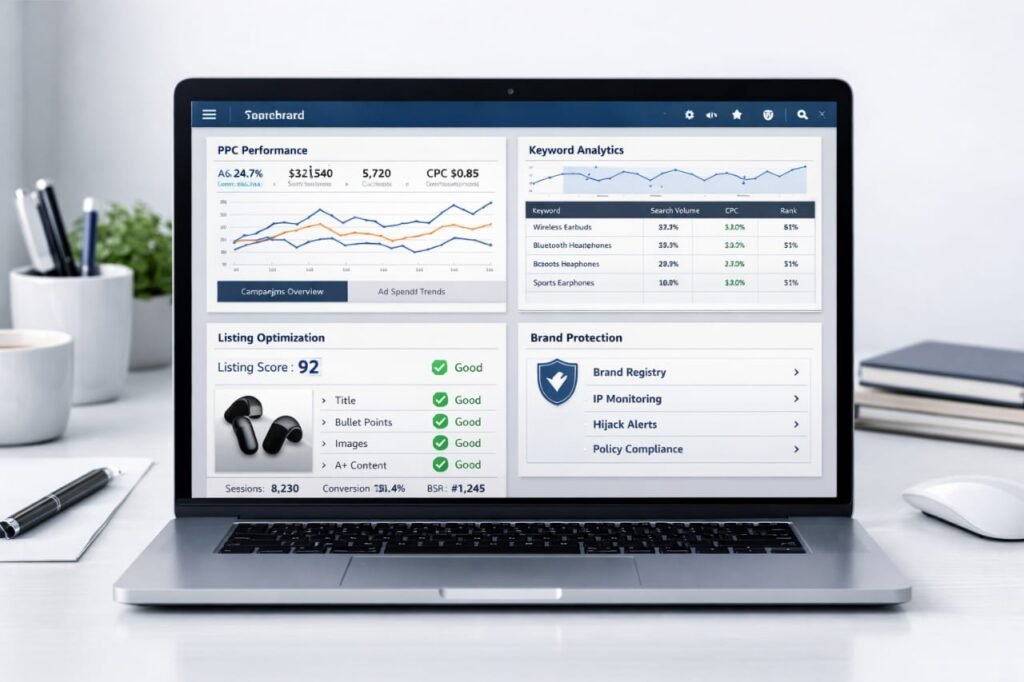
The Amazon Growth System: Strategic Frameworks That Scale Beyond Tactics
The Amazon Growth System: Strategic Frameworks That Scale Beyond Tactics
Introduction:
The Amazon marketplace has matured into one of the most complex, data-driven, and competitive commercial ecosystems in the world. What once rewarded basic listing optimization, aggressive pricing, and tactical advertising now demands a fundamentally different approach—one grounded in systems thinking, strategic orchestration, and scalable frameworks. Sellers who continue to rely on isolated tactics often experience short-term gains followed by stagnation, margin erosion, or operational overload. In contrast, brands that adopt an integrated growth system are able to scale sustainably, defend profitability, and compound advantages over time.
This article introduces The Amazon Growth System: a strategic, end-to-end framework designed for serious operators who want to scale beyond tactics. Rather than focusing on surface-level optimizations, this system aligns market intelligence, brand architecture, operational excellence, advanced advertising mechanics, and data governance into a cohesive engine for growth. The goal is not merely to increase revenue, but to build a resilient Amazon business that performs across economic cycles, algorithm shifts, and competitive pressures.
Written for advanced sellers, brand owners, and Amazon-focused agencies, this blog goes deep into the strategic layers that underpin long-term success. It assumes familiarity with Amazon fundamentals and instead concentrates on how to architect a business that scales deliberately, predictably, and profitably.
From Tactics to Systems: Why Most Amazon Strategies Fail to Scale:
Many Amazon businesses plateau because they are built on disconnected tactics rather than integrated systems. A seller might excel at PPC optimization, but neglect supply chain forecasting. Another may invest heavily in branding, yet lack contribution margin visibility. These imbalances create fragility.
A system, by contrast, is a set of interdependent components designed to produce a repeatable outcome. On Amazon, that outcome is profitable growth. Systems thinking forces operators to move beyond the question of what works and instead ask why it works, under what conditions, and how it connects to everything else.
Key characteristics of a scalable Amazon system include:
Interdependency: Advertising, pricing, inventory, and conversion optimization are managed as a single economic model.
Feedback loops: Data from one function (e.g., PPC search term reports) informs decisions in others (e.g., listing copy, product development).
Constraint awareness: Growth decisions account for capital, logistics, and operational capacity, not just demand.
Standardization: Processes are documented, measurable, and repeatable across SKUs and markets.
Without these elements, growth becomes reactive and increasingly expensive. With them, scale becomes intentional.
Market Intelligence as the Foundation of Growth:
Every scalable Amazon system begins with superior market intelligence. This goes far beyond basic keyword research or competitor price tracking. Advanced market intelligence answers strategic questions such as:
Where is true demand underserved?
Which competitors are structurally weak despite surface-level success?
How sensitive is the category to price, branding, or feature differentiation?
What external forces (seasonality, regulation, platform changes) influence long-term viability?
Demand Mapping, Not Keyword Lists:
Advanced operators model demand at the problem level, not the keyword level. This involves clustering keywords into intent-based demand segments and mapping those segments to customer use cases. The objective is to understand why customers are buying, not just what they are typing.
This approach enables:
More coherent listing narratives
Higher conversion through relevance
Expansion into adjacent product lines with validated demand
Competitive Moat Analysis:
Rather than copying top sellers, system-driven brands analyze competitors through the lens of defensibility. This includes:
Review velocity versus review quality
Brand presence outside Amazon
Operational complexity (bundles, variations, customization)
Cost structure assumptions inferred from pricing behavior
The goal is to identify where competitors are strong and where they are overextended
This blog is designed for Amazon brands ready to move beyond fragmented tactics and build scalable, defensible growth systems.
Get in Touch With Our Amazon Growth ExpertsProduct Architecture and Portfolio Strategy:
Scaling on Amazon is rarely about a single hero SKU. Sustainable growth requires deliberate product architecture—how individual products work together to increase lifetime value, reduce risk, and improve operational efficiency.
Portfolio Roles:
Each product in a mature Amazon catalog should serve a strategic role, such as:
Traffic drivers: High-volume, lower-margin SKUs designed to acquire customers
Profit anchors: Optimized products with strong margins and stable demand
Expansion SKUs: Products that open new subcategories or use cases
Defensive SKUs: Variations or bundles designed to block competitors
Assigning roles allows for clearer investment decisions and prevents over-optimization of the wrong products.
Variation and Bundle Economics:
Advanced sellers use variations and bundles not just for convenience, but for algorithmic and economic leverage. Properly structured, these can:
Consolidate reviews
Increase average order value
Reduce ad competition between owned SKUs
Improve inventory flexibility
However, poor execution can dilute conversion or create fulfillment inefficiencies. System-level modeling is essential.
Brand as a Performance Asset:
On Amazon, brand is often misunderstood as aesthetics alone. In reality, brand is a performance asset that directly influences conversion rate, price elasticity, and advertising efficiency.
Brand Signals and Trust Engineering:
Amazon customers make rapid decisions under uncertainty. Advanced brands intentionally design trust signals into every touchpoint:
Visual hierarchy and image sequencing
Language consistency across listings
Social proof placement
A+ content designed for objection handling, not decoration
These elements reduce cognitive friction and improve conversion at scale.
Brand Registry as an Operational Lever:
Beyond protection, Brand Registry enables:
Advanced content testing
Sponsored Brand defensibility
Attribution modeling
Audience remarketing
Brands that treat registry as a strategic platform—not a compliance checkbox—unlock compounding advantages.
Advertising as a Demand Capture System:
PPC is not an isolated growth lever; it is the primary mechanism through which Amazon demand is captured, shaped, and defended.
Full-Funnel Advertising Architecture:
Advanced Amazon advertising systems align campaigns to funnel stages:
Discovery: Broad, category, and competitor targeting
Consideration: Mid-funnel keyword and product targeting
Conversion defense: Brand and ASIN protection
Retention: Audience and remarketing strategies
Each stage has different success metrics and bid logic.
Contribution Margin–Driven Bidding:
Scaling beyond tactics requires bidding decisions based on contribution margin, not ACoS alone. This includes accounting for:
Storage and fulfillment costs
Returns and defects
Cross-SKU halo effects
Repeat purchase behavior
This financial lens enables rational scaling even at higher visible ACoS levels.
System-Driven Growth
Move beyond isolated optimizations by aligning demand, advertising, inventory, and cash flow into a unified growth system.
Strategic Market Intelligence
Advanced demand mapping and competitive analysis uncover structural opportunities that tactics alone fail to reveal.
Scalable Advertising Architecture
Full-funnel PPC systems built on contribution margin logic enable profitable scale without margin erosion.
Defensible Brand Assets
Brand is engineered as a performance lever—improving conversion, pricing power, and long-term category defense.
Conversion Rate Optimization as a Continuous System:
Rather than one-time listing optimization, mature Amazon brands operate continuous CRO systems.
Hypothesis-Driven Testing:
Every listing element is treated as a testable variable, including:
Image sequencing
Feature framing
Price anchoring
Offer structuring:
Tests are prioritized based on estimated impact and confidence, not intuition.
Integrating CRO with Advertising Data:
Search term data, placement reports, and audience insights feed directly into listing evolution. This creates a feedback loop where advertising improves conversion, and conversion improvements reduce advertising costs.
Inventory as a Strategic Asset:
Advanced operators forecast inventory based on:
Demand elasticity under ad scaling
Lead time variability
Seasonality stress testing
The objective is not to avoid stockouts at all costs, but to optimize capital efficiency.
Cash Flow Modeling:
Every growth decision is constrained by cash flow reality. System-level brands maintain rolling cash flow models that integrate:
Advertising spend
Inventory deposits
Payment cycles
Expansion investments
This discipline prevents growth from becoming a liquidity crisis.
Data Infrastructure and Decision Governance:
As scale increases, intuition must give way to structured decision-making.
Single Source of Truth:
Advanced Amazon businesses invest in centralized data systems that unify:
Sales and traffic
Advertising performance
Inventory and logistics
Financial metrics
This reduces decision latency and misalignment.
Decision Cadence and Accountability:
Growth systems define:
Weekly tactical reviews
Monthly strategic reviews
Quarterly portfolio assessments
Each metric has an owner, a threshold, and a predefined response.

Scaling Across Marketplaces and Channels:
True scale extends beyond a single marketplace.
International Expansion Frameworks:
Rather than reactive expansion, advanced brands use readiness criteria:
Demand validation
Regulatory feasibility
Margin durability
Operational complexity
This prevents dilution of focus and capital.
Amazon as a Channel, Not the Business:
The most resilient Amazon brands treat the platform as one channel within a broader ecosystem that includes:
Direct-to-consumer infrastructure
Email and audience ownership
Off-Amazon brand building
This diversification strengthens negotiating power and long-term valuation.
Conclusion:
The Amazon Growth System is not a checklist or a shortcut. It is a strategic framework designed to replace fragmented tactics with integrated, scalable systems. In an environment where competition intensifies and margins compress, only those brands that think holistically—across market intelligence, product architecture, branding, advertising, operations, and data—will sustain growth.
Scaling beyond tactics requires discipline, patience, and a willingness to invest in structure before speed. The reward is not just higher revenue, but a defensible, adaptable Amazon business capable of compounding value over time.
Who is this growth system designed for?
Can new sellers apply these principles?
How long does it take to see results from a system-based approach?
-
Mary
- December 16, 2025
- 6:30 pm
- Reading time 5 min
Recent Posts
- All Post
- Amazon Compliance
- Amazon FBA Guide
- amazon market analysis
- Amazon PPC
- Amazon Stock
- Amazon Tools
- Business Strategy
- Ecommerce News & Analysis
- Full Account Management Services
- Guide
- Guide 2025
- News
- News 2026
- PPC Services
- Prime day
- Stories
- Team Memebers
- Technology and Digital Services
- Top Agencies
- Top PPC tools
- Why we are Unique?



Get a Quick Solution
Need help fast? Our expert team is here to provide you with efficient and reliable solutions tailored to your needs. Don’t wait—reach out today!
Categories
- Amazon Compliance (5)
- Amazon FBA Guide (6)
- amazon market analysis (2)
- Amazon PPC (30)
- Amazon Stock (1)
- Amazon Tools (17)
- Business Strategy (12)
- Ecommerce News & Analysis (6)
- Full Account Management Services (106)
- Guide 2025 (20)
- News 2026 (16)
- PPC Services (58)
- Prime day (2)
- Technology and Digital Services (1)
- Top PPC tools (1)
- Why we are Unique? (11)
Subscribe for Growth Tips, Seller Hacks & eCom Wins