...
Category Amazon PPC

Why Amazon Sellers Are Overpaying for PPC in 2026 and How to Fix It

Facebook
Twitter
LinkedIn
Reddit
Email
WhatsApp
Pinterest

The Ultimate Guide to Maximizing Your Sales and Amazon Account Performance

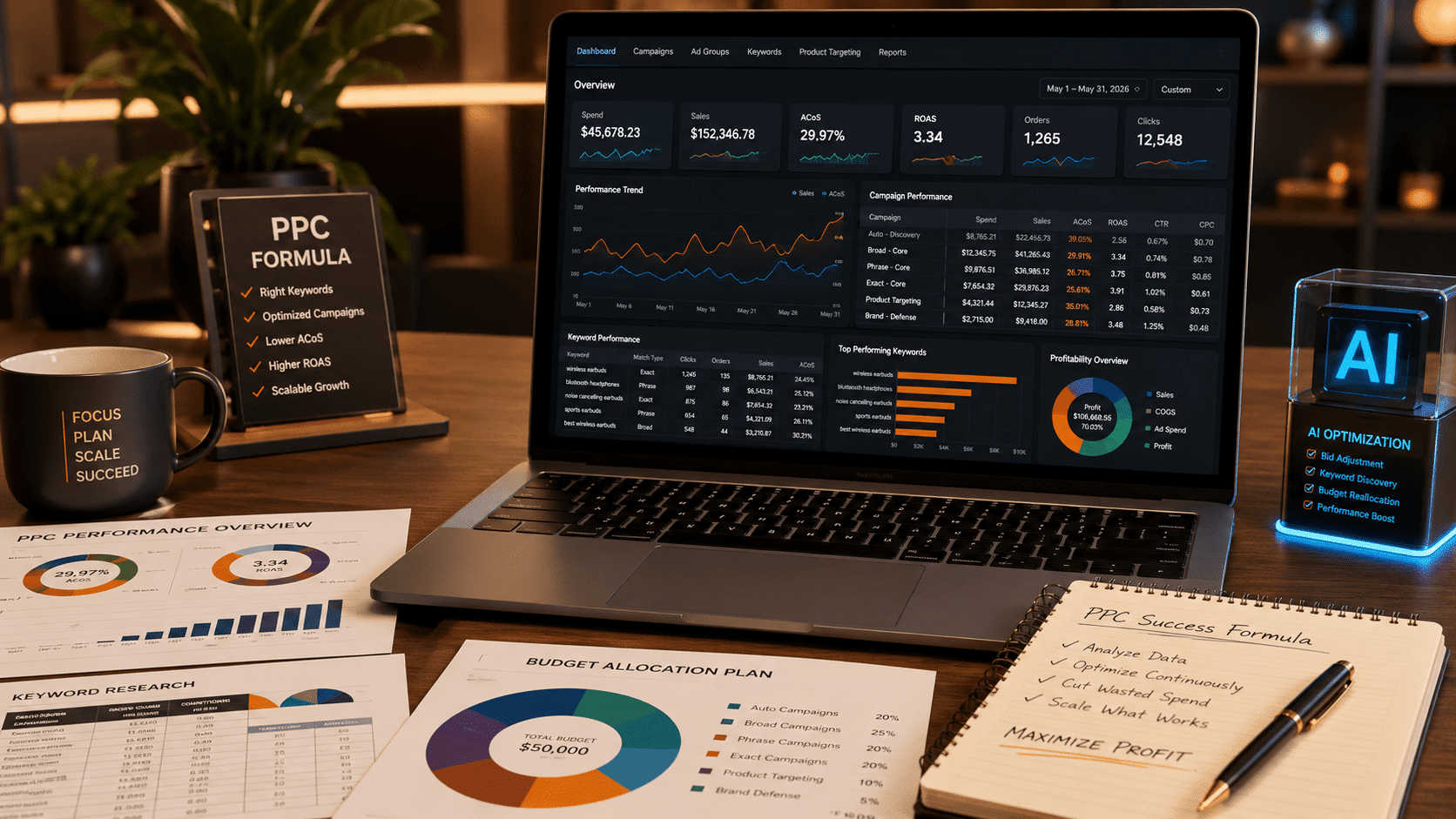
Amazon advertising has become more competitive than ever. As more brands enter the marketplace and bidding costs continue to rise, many sellers are finding themselves spending significantly more on advertising while seeing smaller profit margins.

The problem isn’t necessarily that Amazon PPC has become ineffective. In fact, PPC remains one of the most powerful tools for driving visibility and sales. The real issue is that many sellers are investing heavily in advertising without optimizing the factors that determine long-term profitability.

If your Advertising Cost of Sales (ACOS) continues to increase or your campaigns require more budget every month to maintain the same results, you may be overpaying for PPC without realizing it.

In this guide, we’ll explore the most common reasons Amazon sellers overspend on advertising in 2026 and the practical steps you can take to improve efficiency and profitability.

The Rising Cost of Amazon Advertising:

Amazon’s advertising ecosystem has matured significantly over the last few years. More sellers are competing for the same keywords, resulting in higher cost-per-click (CPC) rates across most product categories.

At the same time, Amazon’s algorithm increasingly rewards products that combine strong advertising performance with high conversion rates, positive customer experiences, and optimized listings.

This means simply increasing ad spend is no longer enough to achieve sustainable growth.

Many sellers respond to declining visibility by raising bids and budgets, but this often creates a cycle where advertising costs increase faster than revenue.

Bidding Aggressively on High-Competition Keywords:

One of the most common reasons sellers overpay for PPC is excessive bidding on broad, highly competitive keywords.

While these keywords may generate traffic, they often attract shoppers who are still comparing products rather than making purchasing decisions.

For example, targeting a keyword such as “wireless headphones” may be significantly more expensive than a long-tail keyword like “wireless noise-canceling headphones for travel.”

Long-tail keywords typically deliver:

  • Lower CPCs
  • Higher conversion rates
  • Better profitability
  • More targeted traffic
How to Fix It:

Focus on identifying long-tail and purchase-intent keywords that align closely with your product. Regularly review search term reports to uncover profitable opportunities that competitors may overlook.

Ignoring Negative Keywords:

Many sellers waste a substantial portion of their advertising budget by allowing ads to appear for irrelevant searches.

Without a strong negative keyword strategy, campaigns can continue spending money on clicks that have little chance of converting into sales.

Even small amounts of wasted spend can accumulate into thousands of dollars annually.

How to Fix It:

Conduct weekly search term audits and add irrelevant or underperforming search terms as negative keywords. This simple process can dramatically improve campaign efficiency over time.

Poor Listing Optimization:

A common misconception is that PPC alone drives sales.

In reality, advertising brings traffic, but your product listing is responsible for converting that traffic into customers.

If your listing has:

  • Weak product images
  • Generic titles
  • Poor bullet points
  • Limited A+ Content
  • Few reviews

then increasing advertising spend will only magnify conversion issues.

How to Fix It:

Before scaling PPC campaigns, ensure your listing is fully optimized. High-converting listings often reduce ACOS because more visitors complete purchases after clicking an ad.

Treating PPC and SEO as Separate Strategies:

Many sellers view Amazon SEO and Amazon PPC as independent channels.

However, Amazon’s ranking system increasingly relies on performance signals generated through advertising campaigns.

When PPC campaigns generate relevant traffic and strong conversions, organic rankings often improve as well.

Ignoring this relationship can lead sellers to spend more on advertising than necessary.

How to Fix It:

Create an integrated strategy where PPC supports keyword discovery and ranking improvements while SEO strengthens long-term organic visibility.

Not Working With PPC Specialists:

Amazon advertising has become increasingly sophisticated. Managing campaigns effectively now requires ongoing keyword research, bid optimization, placement analysis, and performance tracking.

Many sellers attempt to manage PPC internally while simultaneously handling inventory, customer service, and business operations.

This often leads to inefficient spending and missed growth opportunities.

How to Fix It:

Consider partnering with experienced Amazon PPC professionals who can continuously optimize campaigns and identify areas of wasted spend.

A skilled Amazon growth partner can often reduce advertising costs while improving overall sales performance.

The Future of Amazon PPC in 2026:

The sellers achieving the best results in 2026 are not necessarily the ones spending the most on advertising.

They are the ones spending strategically.

Success increasingly depends on combining:

  • Advanced keyword targeting
  • Listing optimization
  • Conversion rate improvement
  • Data-driven bidding
  • Continuous campaign optimization

As competition grows, profitability will become a stronger competitive advantage than simply increasing advertising budgets.

Final Thoughts:

Amazon PPC remains one of the most effective growth channels available to sellers, but rising advertising costs mean efficiency matters more than ever.If your advertising spend continues to increase without a corresponding improvement in profitability, it’s time to evaluate your strategy.

By improving keyword targeting, strengthening listing optimization, implementing negative keywords, and aligning PPC with SEO efforts, sellers can significantly reduce wasted ad spend while generating stronger returns.

The goal isn’t to spend less on Amazon advertising it’s to spend smarter.Businesses that adopt this approach in 2026 will be better positioned to scale profitably and maintain a competitive edge in an increasingly crowded marketplace.

Still Spending Too Much on Amazon PPC?

Get a free expert audit and discover hidden opportunities to improve your profitability.

Facebook
Twitter
LinkedIn
Reddit
Email
WhatsApp
Pinterest

Recent Posts

  • All Post
  • Amazon Compliance
  • Amazon FBA Guide
  • amazon market analysis
  • Amazon PPC
  • Amazon PPC & Advertising
  • Amazon SEO
  • Amazon Stock
  • Amazon Tools
  • Business Strategy
  • eCommerce
  • Ecommerce News & Analysis
  • Full Account Management Services
  • Guide
  • Guide 2025
  • News
  • News 2026
  • PPC Services
  • Prime day
  • Stories
  • Team Memebers
  • Technology and Digital Services
  • Top Agencies
  • Top PPC tools
  • Why we are Unique?

Get a Quick Solution

Need help fast? Our expert team is here to provide you with efficient and reliable solutions tailored to your needs. Don’t wait—reach out today!

Categories

Subscribe for Growth Tips, Seller Hacks & eCom Wins

Subscribe for updates.

Subscribe for Growth Tips, Seller Hacks & eCom Wins

top

Inactive

Seraphinite AcceleratorOptimized by Seraphinite Accelerator
Turns on site high speed to be attractive for people and search engines.