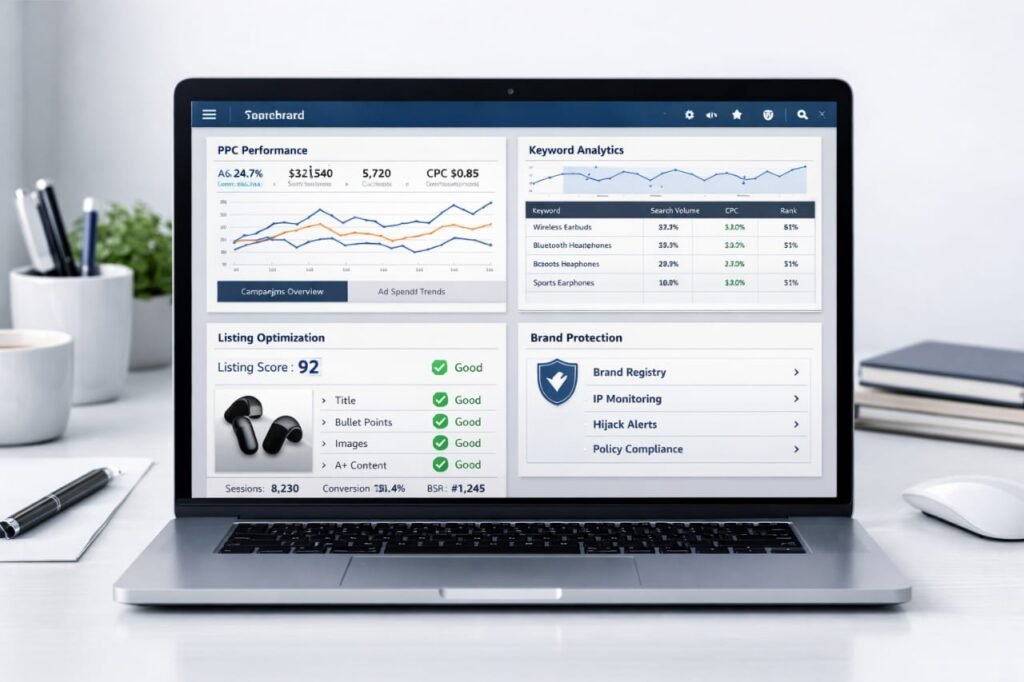
Comprehensive Amazon Store Optimization for Long-Term Growth & Compliance.
Comprehensive Amazon Store Optimization for Long-Term Growth & Compliance.
Introduction:
Amazon store optimization has evolved significantly over the past decade—from simple keyword adjustments to advanced AI-driven strategies that integrate branding, compliance, advertising, and customer behavior. This blog provides a comprehensive, in-depth look into how sellers can build sustainable growth on Amazon while adhering to best practices and marketplace policies. The content is designed for professional sellers seeking advanced insights to refine their long-term strategy and operational excellence.
Building a High-Performance Amazon Store for Sustainable Success:
Optimizing an Amazon store for long-term performance involves far more than adding keywords, editing listings, or launching PPC campaigns. Sellers today must navigate an increasingly competitive marketplace shaped by evolving compliance policies, AI-enhanced search algorithms, industry-wide automation, and customer expectations that continue to rise. To succeed sustainably, brands must adopt a holistic approach that integrates operational efficiency, brand credibility, data-driven decision-making, and strict adherence to Amazon’s policies.
This section explores the deeper layers of Amazon store optimization, covering every critical domain—from catalog structuring to brand governance, from advertising scalability to global marketplace regulations.
Strategic Architecture of a High-Performing Amazon Catalog:
A well-structured catalog sets the foundation for discoverability, compliance, and conversion. It influences indexing, ad performance, inventory forecasting, and even customer trust.
Optimizing Parent-Child Relationships:
Effective variation structuring ensures that all SKUs under a listing benefit from combined reviews, improved ranking, and smooth navigation.
Key best practices include:
- Maintaining variation themes approved by Amazon (size, color, flavor, material, etc.)
- Avoiding cross-category or forced variations
- Ensuring high-resolution images for all child SKUs
- Mapping attributes consistently to enhance keyword relevancy
A misaligned variation setup not only hurts conversion but also increases the likelihood of suppression or inconsistent indexing.
Strengthening Title, Bullet Points, and Product Descriptions:
While keyword placement matters, readability and persuasion are equally important.
Important writing techniques:
- Keep titles informative but concise
- Use bullet points to highlight differentiators
- Maintain semi-technical descriptions for advanced products
- Prioritize benefits before features
Search algorithms increasingly value clarity and relevance over keyword stuffing, so balance is essential.
Get customized Amazon growth solutions designed to elevate your brand performance.
Click below to request your personalized quote and take the next step forward.
Request a QuoteAdvanced Competitor Intelligence & Market Gap Analysis:
A significant aspect of long-term Amazon success lies in understanding competitor behavior through structured intelligence gathering. Brands must routinely evaluate top-performing listings to identify gaps in pricing, product features, review sentiment, and keyword positioning. By mapping competitor strengths and weaknesses against customer expectations, sellers can create a differentiation model that highlights opportunities for product enhancement, packaging improvements, and strategic pricing. Advanced market gap analysis also helps identify underserved niches, emerging trends, and latent customer needs that can guide innovation and reinforce brand authority. With the increasing use of automation and AI-driven analytics, proactive competitive monitoring has become not only beneficial but essential for maintaining relevance in evolving categories.
Leveraging AI-Driven Keyword Intelligence:
Amazon’s A10 algorithm favors listings that are contextually relevant and behaviorally validated. Traditional keyword research must now be complemented with AI insights, user intent forecasting, and competitive pattern analysis.
Advanced Keyword Clustering for Topical Authority:
Rather than using isolated keywords, grouping them into semantic clusters strengthens Amazon’s understanding of what your product truly represents.
Types of keyword clusters:
- Primary intent keywords (core product)
- Transactional keywords (buy, best, top, premium, etc.)
- Long-tail motivator keywords (specific problems solved)
- Complementary keywords (accessories, compatible products)
This layered approach increases organic ranking stability and helps listings withstand competitive shifts.
Customer-Behavior Mapping:
Studying repeat purchase patterns, click-through trends, and sub-niche keyword opportunities enables sellers to craft optimized content tailored to real buyer intent rather than hypothetical search queries.
Brand Positioning & Storytelling for Higher Conversion Rates:
Most Amazon sellers focus on keywords, but long-term brand growth requires a compelling narrative that resonates with customers across all touchpoints.
A+ Content as a Conversion Engine:
Premium visuals, detailed text modules, and comparison charts transform browsing into persuasive brand experience.
What high-converting A+ content includes:
- Problem-solution storytelling
- Unique value propositions
- Brand mission and trust signals
- Feature-benefit infographics
- Technical specifications displayed clearly
A+ content should reinforce confidence, reduce return rates, and create emotional affinity with the product.
Leveraging Brand Storefronts:
Your brand store is not just a digital catalog—it’s a brand-building platform.
Best practices:
- Clean navigation and category segmentation
- Seasonal and campaign-based banners
- Cross-selling and bundled deals
- Featured collections for new launches
- Incorporating lifestyle imagery
An optimized storefront increases average order value (AOV) and supports advertising traffic with improved conversion pathways.
Compliance as the Backbone of Long-Term Marketplace Stability:
Amazon increasingly prioritizes compliance for customer safety and legal adherence. This makes compliance management central to sustainable growth.
Policy Adherence & Listing Compliance:
To avoid suspensions or suppressed listings, sellers must comply with:
- Category-specific product guidelines
- Restricted product lists
- Claims and marketing regulations
- Image & content guidelines
- Safety documentation (MSDS, COA, CPC, etc.)
Avoiding Risky Practices:
Unapproved claims, misleading comparisons, copyright violations, and manipulative review tactics are strictly monitored. Even AI-generated content must be reviewed for policy alignment.
Technical Optimization for Search Visibility:
Technical precision ensures Amazon can crawl, classify, and rank products properly.
Backend Search Terms Optimization:
Amazon allows up to 250 bytes of backend keywords. Strategic usage improves discoverability.
Guidelines:
- Avoid repeating visible keywords
- Include common misspellings
- Add competitor keywords cautiously
- Include regional terms for global listings
Structured Data & Attribute Mapping:
Accurate attributes help customers refine searches and improve buy-box conversion.
Focus on:
- Material
- Size
- Color
- Care instructions
- Dimensions
- Age ranges
| Area | Importance | Impact Level | Recommended Actions |
|---|---|---|---|
| Listing Optimization | High | Strong | Keyword clustering, enhanced visuals |
| Advertising Strategy | Very High | Strong | Multi-tier PPC, retargeting |
| Compliance & Safety | Critical | Maximum | Documentation, policy adherence |
| Inventory Management | High | Strong | Forecasting, IPI monitoring |
Advertising Infrastructure for Scalable Growth
Advertising is no longer optional. PPC serves as a ranking engine and an intelligence source.
Sponsored Products Optimization:
Breaking down campaigns by product type, match type, and search intent provides high control over budget and performance.
Advanced PPC strategies include:
- Search term isolation
- Tiered bidding architectures
- Intent-based campaign grouping
- Negative keyword sculpting
- ASIN targeting for competitor conquesting
Sponsored Brands for Visibility:
Using banners and video ads drives brand awareness while complementing Sponsored Products campaigns.
Sponsored Display for Retargeting:
Retargeting improves ROAS by capturing customers further in the purchase funnel through interest-based and behavioral signals.
Inventory, Fulfillment & Operational Excellence:
Operational excellence ensures Amazon’s algorithm trusts your store.
Inventory Health & IPI Score:
A high Inventory Performance Index is essential for storage access, ranking stability, and smooth replenishment cycles.
Focus on:
- Reducing aging stock
- Maintaining appropriate sell-through rates
- Accurate demand forecasting
- Avoiding stockouts
FBA vs. FBM Optimization:
Many brands use a hybrid model, balancing FBA convenience with FBM flexibility.

Global Expansion Strategy for Marketplace Diversity:
Amazon’s global marketplaces offer accelerated brand growth if approached strategically.
Market Evaluation Framework:
Before launching internationally, evaluate:
- Pricing structure changes
- Local competition
- Cultural demand shifts
- Shipping and customs logistics
Localized Content Optimization:
All content should be rewritten—not merely translated—to align with local search intent.
Packaging, Inserts & Post-Purchase Optimization:
Customer satisfaction continues after purchase.
Best Practices for Product Inserts:
Compliant inserts can encourage loyalty without violating Amazon policies.
Packaging Optimization:
Eco-friendly, durable, and visually appealing packaging reduces returns and enhances customer trust.
Lifecycle Management & Continuous Optimization Framework:
Amazon store optimization is a continuous lifecycle rather than a single-phase process. Brands must implement a cyclical optimization framework that evaluates product performance across various stages—from launch and growth to maturity and saturation. This approach requires regular enhancements to listing content, periodic audits of advertising efficiency, ongoing refinement of inventory strategy, and strategic adaptation to algorithmic changes. Continuous improvement also involves analyzing customer feedback patterns to drive product upgrades, addressing evolving compliance requirements, and recalibrating marketing strategies to suit competitive dynamics. By treating optimization as a dynamic lifecycle practice, sellers align with Amazon’s fast-paced environment and ensure their products maintain relevance, profitability, and strong ranking positions over time.
Get a free professional audit tailored to your Amazon store’s performance.
Click below to request your complimentary analysis and identify growth opportunities.
Get Free AuditData Analytics & AI-Driven Optimization:
Data is at the core of long-term Amazon success.
Key Metrics to Track:
- Session conversion rate
- CTR
- Customer return rate
- Inventory aging
- Profit margins
- Advertising cost of sale (ACoS)
- Total advertising cost of sale (TACoS)
Predictive Modeling:
Using AI tools helps forecast demand, optimize pricing, and identify hidden opportunities.
Reputation Management & Review Strategy:
A strong reputation protects your brand and grows your customer base.
Collecting Compliant Reviews:
Avoid any incentivized or manipulated review tactics—Amazon monitors patterns closely.
Responding to Negative Feedback:
Professional responses help recover customer trust and improve product quality perception.
Performance Governance & Risk Mitigation:
Compliance monitoring, performance analytics, and prompt issue resolution prevent account-level trouble.
Key Focus Areas:
- Order defect rate
- Late shipment rate
- Valid tracking rate
Buyer-seller communication score
Conclusion:
Long-term success on Amazon requires a strategic blend of catalog optimization, compliance, brand building, data intelligence, and advertising mastery. Sellers who adopt a holistic approach not only strengthen their competitive position but also future-proof their business against algorithm shifts, policy changes, and rising customer expectations. Consistency, innovation, and compliance together create a powerful pathway to accelerated brand growth.
How often should I update my Amazon listings?
Is Amazon PPC necessary for organic ranking?
What is the biggest compliance mistake sellers make?
How can I improve my store’s long-term stability?
-
Mary
- November 21, 2025
- 2:54 pm
- Reading time 5 min
Recent Posts
- All Post
- Amazon Compliance
- Amazon FBA Guide
- amazon market analysis
- Amazon PPC
- Amazon Stock
- Amazon Tools
- Business Strategy
- Ecommerce News & Analysis
- Full Account Management Services
- Guide
- Guide 2025
- News
- News 2026
- PPC Services
- Prime day
- Stories
- Team Memebers
- Technology and Digital Services
- Top Agencies
- Top PPC tools
- Why we are Unique?


Get a Quick Solution
Need help fast? Our expert team is here to provide you with efficient and reliable solutions tailored to your needs. Don’t wait—reach out today!
Categories
- Amazon Compliance (5)
- Amazon FBA Guide (6)
- amazon market analysis (2)
- Amazon PPC (30)
- Amazon Stock (1)
- Amazon Tools (17)
- Business Strategy (12)
- Ecommerce News & Analysis (6)
- Full Account Management Services (106)
- Guide 2025 (20)
- News 2026 (16)
- PPC Services (58)
- Prime day (2)
- Technology and Digital Services (1)
- Top PPC tools (1)
- Why we are Unique? (11)
Subscribe for Growth Tips, Seller Hacks & eCom Wins