Beyond Optimization: A Systematic Approach to Long‑Term Amazon Growth
Beyond Optimization: A Systematic Approach to Long‑Term Amazon Growth
Introduction:
For more than a decade, Amazon growth conversations have revolved around optimization. Sellers are taught to optimize listings, bids, images, keywords, pricing, reviews, and logistics. While optimization remains necessary, it is no longer sufficient. In today’s hyper‑competitive Amazon ecosystem, optimization is the baseline—not the growth strategy.
Mature marketplaces behave differently from emerging ones. As Amazon has evolved into a highly efficient, data‑dense environment, incremental optimizations produce diminishing returns. Sellers who rely solely on tactical improvements often experience plateaued revenue, margin erosion, and operational fragility. Long‑term growth now requires a systematic, portfolio‑level approach that integrates brand architecture, operational leverage, demand creation, and organizational discipline.
This blog explores an advanced framework for sustainable Amazon growth—one that moves beyond surface‑level optimization toward durable systems. It is designed for experienced sellers, brand operators, and aggregators who understand Amazon fundamentals and are seeking long‑term scalability, resilience, and enterprise value creation.
Why Optimization Alone No Longer Drives Sustainable Growth?
Optimization focuses on improving what already exists. It assumes that the core structure—product portfolio, positioning, supply chain, and demand source—is fundamentally sound. In reality, many Amazon businesses are built on fragile foundations that optimization cannot fix.
Several structural shifts have reduced the effectiveness of pure optimization:
- Market Saturation: Most profitable niches are crowded with competent sellers using similar tools, suppliers, and playbooks.
• Algorithm Sophistication: Amazon’s A10+ systems prioritize long‑term customer value, external traffic signals, and brand authority—factors not fully controllable through listing tweaks.
• Rising Costs: Advertising, fulfillment, and storage costs compress margins, making micro‑optimizations less impactful.
• Consumer Trust Evolution: Customers increasingly favor recognizable brands over generic listings, regardless of keyword relevance.
Optimization is tactical. Growth is strategic. Sustainable Amazon success requires designing systems that compound advantages over time.
Reframing Amazon Growth as a System, Not a Tactic:
A system is a set of interdependent components designed to achieve a long‑term objective. In Amazon growth, this objective is not short‑term sales spikes but predictable, profitable expansion.
A systematic growth model integrates five core layers:
- Market Intelligence & Strategic Positioning
- Portfolio & Lifecycle Management
- Demand Engineering
- Operational Leverage & Cost Control
- Organizational & Data Infrastructure
Each layer reinforces the others. Weakness in one eventually limits the entire system
Market Intelligence Beyond Keyword Research:
Most sellers equate market research with keyword volume and competitor listings. Advanced growth begins much earlier—with behavioral and structural intelligence.
Customer Job Mapping:
Instead of asking “What keywords convert?”, ask:
- What problem is the customer truly solving?
• What alternatives exist outside Amazon?
• What trade‑offs does the customer accept?
Mapping customer jobs uncovers unmet needs that keyword tools cannot reveal, allowing differentiation that competitors cannot easily replicate.
Competitive Moat Analysis:
True competitors are not only top‑ranking ASINs. They include:
- Substitute products
• Private label clones - • Retail brands entering Amazon
• International manufacturers selling direct
Understanding competitors’ supply chains, capital structure, and brand leverage enables defensive and offensive strategy design.
Demand Elasticity Assessment:
Advanced sellers measure:
- Price sensitivity
• Promotion dependency
• Review‑driven conversion volatility
This determines whether a product can support premium pricing or requires volume‑based scale.
Strategic Positioning in a Commoditized Marketplace:
Positioning is not branding aesthetics—it is economic logic.
Strong Amazon positioning answers three questions:
- Why should this customer choose this product?
• Why should Amazon’s algorithm prefer it?
• Why will this advantage persist over time?
Vertical vs Horizontal Positioning:
Horizontal products compete on price and keywords. Vertical products compete on specificity and expertise.
Examples of vertical positioning:
- “Joint pain relief for runners over 40”
• “Minimalist kitchen tools for small apartments”
Vertical focus reduces competition, increases loyalty, and stabilizes conversion rates.
Algorithm‑Aligned Differentiation:
Amazon rewards:
- Consistent conversion
• Low return rates
• High repeat purchase behavior
• External traffic signals
Positioning must align with these metrics, not just visual branding.
Portfolio Design for Long‑Term Stability:
Single‑SKU growth is inherently fragile. Sustainable Amazon businesses operate portfolios.
Core, Expansion, and Experimental SKUs:
Advanced portfolios classify products into:
- Core SKUs: Primary revenue drivers with predictable demand
• Expansion SKUs: Line extensions that increase AOV and LTV
• Experimental SKUs: High‑risk, high‑reward launches
Each category has different margin expectations, advertising budgets, and success metrics.
Lifecycle‑Based Decision Making:
Products move through stages:
- Launch
• Acceleration
• Maturity
• Decline
Systematic sellers plan exit strategies as deliberately as launch strategies, reallocating capital before decline erodes profitability.
Demand Engineering: Creating Demand, Not Chasing It:
Optimization reacts to demand. Growth systems create it.
External Traffic as Strategic Asset:
External traffic is not just a ranking lever—it is data ownership.
Benefits include:
- Audience retargeting
- • Brand recall
• Algorithm reinforcement
• Reduced dependency on PPC
Advanced brands treat Amazon as a conversion engine, not a discovery engine.
Content‑Led Demand Creation:
High‑performing brands invest in:
- Educational content
• Influencer partnerships
• Community‑driven narratives
This creates pre‑qualified demand that converts at lower acquisition cost.
Demand Stabilization Mechanisms:
Stability matters more than spikes
Mechanisms include:
- Subscribe & Save optimization
• Product bundling
• Seasonal inventory smoothing
Strategic Evaluation: Systematic Amazon Growth
✔ Pros
- Long-term scalability: Growth systems compound over time rather than relying on constant tactical adjustments.
- Reduced algorithm dependency: Brand-led demand stabilizes sales even during ranking or policy shifts.
- Higher enterprise value: Systematic businesses attract investors, acquirers, and premium valuations.
- Operational resilience: Strong supply chains and data systems reduce risk and volatility.
⚠ Cons
- Slower initial results: Systems take time to mature compared to short-term optimization wins.
- Higher upfront investment: Branding, infrastructure, and strategy require capital and planning.
- Operational complexity: Managing portfolios and data systems demands experienced execution.
- Not beginner-friendly: This approach is best suited for established sellers, not early-stage launches.
Advertising as a Profit System, Not a Cost Center”
Most sellers treat PPC as fuel. Advanced sellers treat it as an investment portfolio.
Segmented Advertising Architecture:
Instead of campaign sprawl, mature systems use:
- Brand defense campaigns
• Market capture campaigns - • Profit harvesting campaigns
- • Discovery campaigns
Each has clear ROAS and TACOS expectations.
Incrementality Measurement:
True performance is measured by incremental lift, not attribution reports.
Advanced operators regularly test:
- Ad‑off periods
• Geo‑based exclusions • Branded vs non‑branded lift
Operational Leverage and Cost Discipline:
Growth without operational control destroys value.
Supply Chain as Strategic Weapon:
Advanced sellers design supply chains for:
- Redundancy
- • Speed
- • MOQ flexibility •
- Cost predictability
This reduces stock‑out risk and pricing pressure.
Cost Transparency Systems:
Mature businesses track:
- Contribution margin per ASIN
• Variable vs fixed cost allocation
• Cash conversion cycles
Decisions are made on contribution, not revenue.
Organizational Systems and Decision Velocity:
Long‑term growth is constrained by decision speed and clarity.
Role Specialization:
High‑scale brands separate:
- Strategy
• Execution - • Analysis
This prevents founder bottlenecks and operational burnout.
Data as Governance Tool:
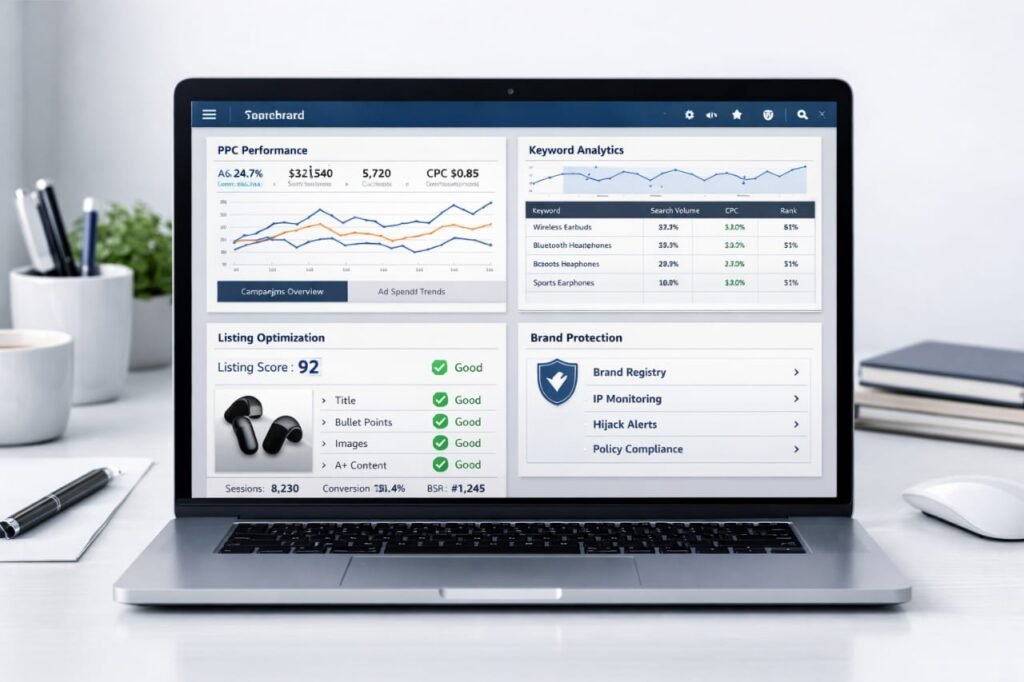
Dashboards are not reports—they are decision systems.
Advanced sellers track:
- Leading indicators (conversion, inventory health)
• Lagging indicators (profit, cash flow)

Risk Management and Resilience Planning:
Amazon businesses fail more often from shocks than competition.
Systematic growth includes:
- Account suspension contingencies
• Supplier diversification - • Channel expansion planning
• Cash reserves
Resilience is a growth multiplier.
Lorem ipsum dolor sit amet, consectetur adipiscing elit. Ut elit tellus, luctus nec ullamcorper mattis, pulvinar dapibus leo.
Measuring What Actually Matters:
Advanced KPIs move beyond surface metrics.
Key long‑term indicators include:
- Customer lifetime value
• Brand search volume growth - • Repeat purchase rate
• Organic sales stability
These predict durability, not just success.
Conclusion:
Beyond optimization lies a more demanding—but far more rewarding—approach to Amazon growth. Sustainable success is not built through isolated tactics but through interconnected systems designed for durability, adaptability, and compounding advantage.
As competition intensifies and costs rise, sellers who rely on optimization alone will continue to struggle with plateaus and volatility. Those who invest in strategic positioning, portfolio intelligence, demand creation, and operational discipline will build brands that survive algorithm shifts, resist commoditization, and generate long‑term enterprise value.
Amazon growth is no longer about being better than competitors at the same tactics. It is about designing a fundamentally stronger system.
Is optimization still important for Amazon growth?
How long does it take to see results from a systematic approach?
-
Mary
- December 18, 2025
- 3:04 pm
- Reading time 5 min
Recent Posts
- All Post
- Amazon Compliance
- Amazon FBA Guide
- amazon market analysis
- Amazon PPC
- Amazon Stock
- Amazon Tools
- Business Strategy
- Ecommerce News & Analysis
- Full Account Management Services
- Guide
- Guide 2025
- News
- News 2026
- PPC Services
- Prime day
- Stories
- Team Memebers
- Technology and Digital Services
- Top Agencies
- Top PPC tools
- Why we are Unique?


Get a Quick Solution
Need help fast? Our expert team is here to provide you with efficient and reliable solutions tailored to your needs. Don’t wait—reach out today!
Categories
- Amazon Compliance (5)
- Amazon FBA Guide (6)
- amazon market analysis (2)
- Amazon PPC (30)
- Amazon Stock (1)
- Amazon Tools (17)
- Business Strategy (12)
- Ecommerce News & Analysis (6)
- Full Account Management Services (106)
- Guide 2025 (20)
- News 2026 (16)
- PPC Services (58)
- Prime day (2)
- Technology and Digital Services (1)
- Top PPC tools (1)
- Why we are Unique? (11)
Subscribe for Growth Tips, Seller Hacks & eCom Wins