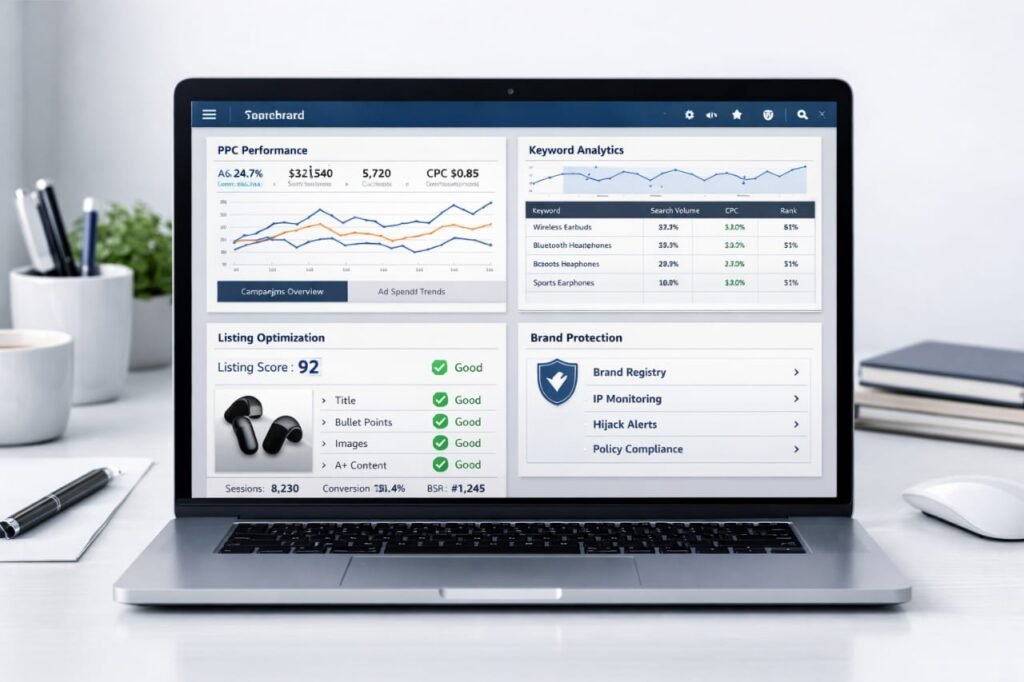
How to Build an Amazon Business That Scales—Strategically
How to Build an Amazon Business That Scales—Strategically
Introduction:
Building an Amazon business is no longer about finding a trending product, launching fast, and hoping advertising carries the rest. In 2025 and beyond, Amazon has evolved into a highly competitive, data-driven ecosystem where scalability depends on systems, strategy, and long-term thinking, not tactics alone.
Many sellers reach early revenue milestones—$10K, $50K, even $100K per month—only to stall, struggle with cash flow, lose rankings, or burn profit on ads. The reason is simple: most Amazon businesses are built to start, not to scale.
A scalable Amazon business is intentionally designed from the ground up. It aligns product selection with capital efficiency, operations with automation, advertising with lifetime value, and brand positioning with defensibility. This article provides an advanced strategic blueprint—from foundational decision frameworks to operational scalability—so you can build an Amazon business that grows predictably, profitably, and sustainably.
Understanding Scalability in the Amazon Context:
Scalability on Amazon is often misunderstood. Growth alone does not equal scale.
True scalability means:
Revenue can increase without proportional increases in cost or complexity
Margins remain stable or improve as volume grows
Operations, advertising, and inventory remain controllable at higher scale
The business becomes more resilient to Amazon policy changes, competition, and ad inflation
A non-scalable Amazon business depends heavily on:
One product
One traffic source (usually PPC)
Manual processes
Thin margins
A scalable Amazon business is system-based, not seller-dependent.
Strategic Product Selection: The First Scaling Decision:
Scalability begins before launch—at product selection.
Beyond Demand and Competition:
Advanced sellers evaluate products through scalability filters, not just demand metrics:
Contribution margin after ads
Inventory velocity vs. capital lock
Supplier scalability
Listing expandability
Brand extension potential
A product that sells well but ties up capital for 90 days with low margins is a bottleneck, not an asset.
Unit Economics as a Scaling Constraint:
Every scalable business starts with healthy unit economics:
Gross margin: ideally 60–70%
Net margin (post ads): minimum 20–30%
Advertising dependency: decreasing over time
If a product only works at low volume or relies on aggressive PPC, it will collapse at scale.
Building a Listing That Scales with Traffic:
A scalable Amazon listing is not optimized for launch—it is optimized for traffic multiplication.
Conversion Optimization as a Growth Lever:
At scale, small conversion improvements produce massive revenue gains.
Advanced listing optimization includes:
Data-driven image sequencing
Benefit-led copywriting
Objection-handling visuals
Mobile-first design
Keyword intent mapping (not stuffing)
Conversion rate is a profit multiplier.
Want to build a scalable Amazon business with expert guidance?
Get a custom strategy tailored to your growth goals.
Brand-First Thinking vs. SKU-First Thinking:
One of the biggest strategic mistakes sellers make is building SKUs instead of brands.
Why Brands Scale Better Than Products:
Brands allow you to:
Increase conversion rates organically
Lower long-term PPC costs
Expand product lines under existing trust
Build off-Amazon leverage
Increase business valuation
Amazon rewards brands with:
Brand Registry tools
Enhanced Brand Content
Brand Analytics data
Storefront authority
Strategic Brand Positioning:
Advanced Amazon brands are positioned intentionally:
Clear customer avatar
Emotional and functional differentiation
Consistent messaging across listings
Premium or value alignment—not both
A brand that stands for something scales faster than a generic product catalog.
Advertising as a System, Not a Cost:
Most sellers treat Amazon PPC as an expense. Scalable businesses treat it as an investment system.
Strategic PPC Architecture:
Advanced PPC systems include:
Structured campaign hierarchies
Intent-based keyword segmentation
Search term harvesting loops
Defensive brand campaigns
Sponsored Brand and Display integration
Scaling PPC without structure leads to:
Rising ACOS
Data blindness
Cash burn
Profit-Led Advertising Decisions:
Scalable brands optimize for:
TACOS, not ACOS
Contribution margin per SKU
Incremental growth, not vanity impressions
Long-term ranking velocity
Advertising should support brand momentum, not replace it.
Inventory Management as a Scaling Backbone:
Inventory is the most underestimated scaling constraint on Amazon.
Cash Flow vs. Growth Balance:
Fast growth can kill a business if inventory planning is weak.
Scalable inventory systems focus on:
Demand forecasting
Lead-time buffers
Reorder point automation
Multi-supplier redundancy
Storage cost optimization
Inventory mismanagement leads to:
Stockouts (ranking loss)
Overstocks (cash freeze)
Storage penalties
Supplier stress
Building an Amazon Business That Scales Requires Systems, Not Shortcuts
Sustainable growth on Amazon is achieved through structured decision frameworks, disciplined unit economics, and brand-first execution. Businesses that scale successfully are designed to absorb growth without increasing complexity, risk, or margin erosion.
Operational Systems and Automation:
Scaling requires removing the founder from daily operations.
Process Documentation:
Every scalable Amazon business documents:
Listing creation workflows
Launch processes
PPC optimization routines
Inventory reordering rules
Customer service SOPs
If a task cannot be delegated, it cannot scale.
Leveraging Tools and Teams:
Advanced sellers use:
Automation tools for PPC and inventory
Virtual assistants for execution
Agencies for specialized tasks
Dashboards for decision-making
The goal is decision leverage, not manual control.
Data-Driven Decision Frameworks:
Scalable businesses are built on leading indicators, not gut instinct.
Key metrics include:
Contribution margin per SKU
Cash conversion cycle
Customer acquisition cost vs. LTV
Ranking sustainability
Inventory turnover ratio
Advanced sellers ask:
“Does this decision improve system efficiency?”
“Does this create leverage six months from now?”
Expansion Without Overextension:
Scaling strategically means expanding when systems are ready, not when revenue allows it.
Product Line Expansion:
Expansion works when:
The brand has authority
Existing products fund growth
New SKUs reduce dependency risk
Operational complexity is controlled
Marketplace and Channel Expansion:
Before expanding internationally or off-Amazon:
Domestic systems must be stable
Cash flow must support delays
Brand consistency must be protected
Growth without control is fragile.

Building Defensibility Against Competition:
Scalable Amazon businesses are hard to copy.
Defensibility comes from:
Brand loyalty
Superior listings
Optimized supply chains
Customer data insights
Multi-channel presence
The goal is not to avoid competition—but to outgrow and outlast it.
Conclusion:
Building an Amazon business that scales strategically requires a fundamental mindset shift—from short-term tactics to long-term systems.
Scalability is not achieved by launching more products, spending more on ads, or chasing trends. It is built through intentional decisions, strong unit economics, brand-first thinking, and operational discipline.
The sellers who win on Amazon long-term are not the fastest movers—they are the best architects. They design businesses that grow without breaking, adapt without panic, and scale without losing profitability.
If you build your Amazon business as a system—not a hustle—you create an asset that compounds over time, survives platform changes, and holds real enterprise value.
How long does it take to build a scalable Amazon business?
Is PPC necessary for scaling on Amazon?
Can a single-product Amazon business scale?
-
Mary
- December 20, 2025
- 2:46 pm
- Reading time 5 min
Recent Posts
- All Post
- Amazon Compliance
- Amazon FBA Guide
- amazon market analysis
- Amazon PPC
- Amazon Stock
- Amazon Tools
- Business Strategy
- Ecommerce News & Analysis
- Full Account Management Services
- Guide
- Guide 2025
- News
- News 2026
- PPC Services
- Prime day
- Stories
- Team Memebers
- Technology and Digital Services
- Top Agencies
- Top PPC tools
- Why we are Unique?
Get a Quick Solution
Need help fast? Our expert team is here to provide you with efficient and reliable solutions tailored to your needs. Don’t wait—reach out today!
Categories
- Amazon Compliance (5)
- Amazon FBA Guide (6)
- amazon market analysis (2)
- Amazon PPC (30)
- Amazon Stock (1)
- Amazon Tools (17)
- Business Strategy (12)
- Ecommerce News & Analysis (6)
- Full Account Management Services (106)
- Guide 2025 (20)
- News 2026 (16)
- PPC Services (58)
- Prime day (2)
- Technology and Digital Services (1)
- Top PPC tools (1)
- Why we are Unique? (11)
Subscribe for Growth Tips, Seller Hacks & eCom Wins