Never Run Out of Stock Again The Ultimate FBA Inventory Management Guide
Never Run Out of Stock Again The Ultimate FBA Inventory Management Guide
Introduction:
Inventory availability is one of the most critical determinants of success for Amazon FBA sellers operating at scale. Stockouts do not merely pause revenue generation. They trigger ranking erosion weaken algorithmic trust increase advertising costs and disrupt cash flow cycles. In competitive categories a single prolonged out of stock event can permanently displace a listing from its historical position.
As Amazon continues to refine its fulfillment network storage limits restock thresholds and performance based capacity systems inventory management has evolved into a strategic discipline rather than an operational task. Sellers who rely on static reorder points manual spreadsheets or reactive purchasing decisions are increasingly exposed to risk.
This guide presents an advanced framework for Amazon FBA inventory management designed for professional sellers brand owners and operators managing complex catalogs global supply chains and fluctuating demand signals. The objective is simple but demanding ensure uninterrupted availability while minimizing excess inventory capital lockup and operational inefficiencies.
By the end of this guide you will understand how to design predictive inventory systems align procurement with demand velocity leverage Amazon data signals and maintain optimal stock health across all stages of growth.
Understanding the True Cost of Stockouts:
Running out of inventory affects far more than immediate sales volume. The Amazon marketplace is governed by performance based algorithms that reward consistency reliability and conversion stability.
When a product goes out of stock several cascading effects occur. Organic keyword rankings deteriorate due to lost sales velocity. Advertising campaigns lose momentum and must be relaunched at higher bids. Buy box share declines even after restocking. Customer trust erodes as listings display unavailable messaging.
Beyond platform effects there are internal financial consequences. Fixed costs such as advertising software labor and overhead continue while revenue pauses. Cash flow becomes unpredictable which delays reorders and compounds the issue.
Advanced sellers model stockouts as opportunity cost events rather than simple sales gaps. Every day without inventory has long tail consequences that extend weeks or months beyond the actual outage.
Amazon FBA Inventory Ecosystem Overview:
Effective inventory management begins with understanding how Amazon evaluates and constrains inventory behavior.
Amazon assigns inventory performance metrics that directly influence storage capacity restock limits and fees. These metrics assess sell through rate stranded inventory excess units and stock age. Poor performance results in restricted inbound shipments increased long term storage fees and reduced operational flexibility.
Amazon also differentiates between standard size and oversized inventory seasonal demand profiles and regional fulfillment constraints. Sellers must therefore manage inventory not just at the SKU level but at the fulfillment network level.
Professional operators treat Amazon as a dynamic logistics partner with evolving rules rather than a passive warehouse. Inventory strategies must be continuously adjusted to align with Amazon policy updates capacity announcements and performance feedback.
Demand Forecasting Beyond Historical Averages:
Most sellers forecast demand using trailing sales averages. While sufficient at low volume this approach fails under volatility seasonality or growth acceleration.
Advanced demand forecasting integrates multiple data layers. These include historical sales velocity seasonality coefficients promotional uplift factors advertising spend projections and external demand indicators.
Seasonality modeling adjusts baseline demand according to predictable calendar driven changes such as holidays pay cycles or category specific events. Growth modeling incorporates trend acceleration driven by brand expansion reviews accumulation or off Amazon marketing.
Advertising driven demand must be forecasted separately. Sponsored ads generate incremental demand that does not always persist organically. Failing to isolate this effect leads to understocking when campaigns scale.
Leading sellers use rolling forecasts updated weekly rather than static monthly projections. This allows procurement decisions to reflect real time performance shifts and mitigates forecast drift.
Want to eliminate stockouts and scale your Amazon FBA business with precision?
Work with experts who design advanced inventory systems built for sustainable growth.
Lead Time Deconstruction and Buffer Engineering:
Lead time is often misunderstood as a single number. In reality it is a composite of multiple sequential stages each with its own variability.
Production lead time includes raw material sourcing manufacturing queue and quality inspection. Transit lead time includes port congestion customs clearance inland transport and carrier delays. Amazon receiving lead time includes check in processing and FC transfer.
Advanced inventory planning decomposes lead time into these components and assigns risk adjusted buffers to each. Rather than adding a flat safety stock percentage sellers apply probabilistic buffers based on historical variance at each stage.
For example transit delays may require larger buffers during peak shipping seasons while production buffers may be reduced with reliable suppliers. This precision reduces excess inventory while maintaining service level targets.
Reorder Point Systems That Scale:
The reorder point defines when replenishment should occur. Basic models use a fixed formula based on average daily sales multiplied by lead time plus safety stock.
At scale this approach becomes insufficient. Velocity fluctuates daily lead times change seasonally and Amazon capacity limits constrain inbound volumes.
Advanced reorder systems are dynamic. They recalculate reorder triggers continuously using rolling demand forecasts live inventory positions inbound shipments and risk buffers.
These systems also incorporate minimum order quantities supplier constraints and cash flow limits. The goal is not simply to reorder on time but to reorder optimally.
Professional sellers maintain different reorder logic for fast moving core products versus slow moving long tail items. Treating all SKUs uniformly creates inefficiencies and capital waste.
Managing Multi SKU and Variation Complexity:
As catalogs expand inventory complexity increases nonlinearly. Variations bundles and multipacks introduce interdependencies that complicate forecasting and replenishment.
Variation level demand must be forecasted independently while also aligning with parent level advertising and ranking dynamics. Stockouts at the child level can impact the entire variation family.
Bundle inventory requires component level tracking to prevent phantom availability. Running out of one component can halt bundle sales even if other components are overstocked.
Advanced operators implement bill of materials logic within inventory systems to synchronize component availability and finished goods planning.
Demand Intelligence
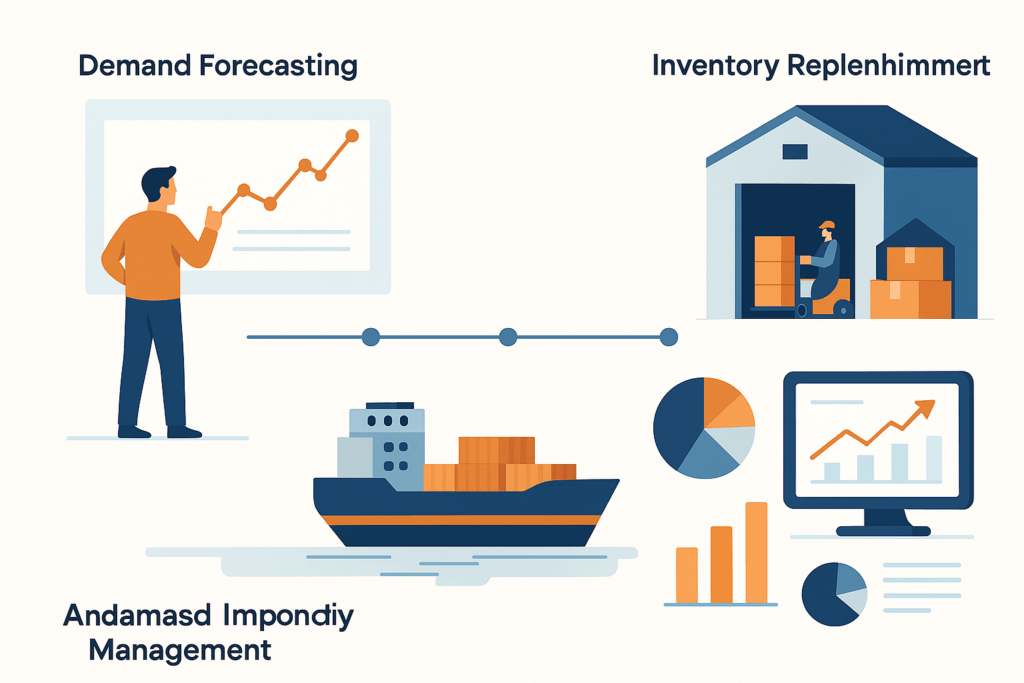
Inventory decisions are driven by rolling demand forecasts that separate organic velocity from advertising driven sales and seasonal lift.
Lead Time Control
Production shipping and Amazon receiving are managed as independent timelines with risk buffers assigned to each stage.
Reorder Logic
Replenishment triggers are recalculated weekly using inbound coverage sell through rates and capacity constraints.
Capacity Strategy
Storage is allocated to SKUs with the highest return per cubic foot rather than evenly distributed across the catalog.
Amazon Storage Limits and Capacity Optimization:
Amazon storage limits have transformed inventory strategy. Unlimited storage is no longer available and inefficient inventory behavior is penalized.
Sellers must actively manage inventory age distribution to maintain favorable storage metrics. This involves prioritizing inbound shipments for high velocity SKUs while throttling slow movers.
Inventory removal liquidation and promotional clearance strategies become integral to capacity management. Holding obsolete inventory reduces available space for profitable products.
Sophisticated sellers model inventory as a portfolio allocating capacity to SKUs based on return on storage rather than emotional attachment or sunk cost bias.
Inventory Health Metrics That Matter:
Beyond stock level counts advanced sellers monitor a suite of inventory health metrics.
Weeks of cover measures how long current inventory will last at forecasted demand. Sell through rate evaluates how efficiently inventory converts to sales. Stock age highlights capital lockup risk.
Inbound coverage tracks future availability considering shipments in transit. Stranded inventory metrics identify listings disconnected from active offers.
These metrics are reviewed weekly if not daily. Dashboards integrate Amazon data with internal systems to provide actionable insights rather than raw numbers.
Automation and Inventory Technology Stack:
Manual inventory management does not scale. Advanced sellers deploy integrated technology stacks to automate forecasting replenishment and exception management.
Inventory planning software ingests Amazon sales data advertising metrics supplier lead times and transit tracking. It generates reorder recommendations scenario simulations and risk alerts.
Enterprise resource planning systems synchronize purchasing accounting and logistics. Forecasting engines use machine learning to adapt to demand shifts.
Automation does not eliminate human oversight. Instead it elevates decision making from reactive firefighting to strategic optimization.
Aligning Inventory with Cash Flow Strategy:
Inventory is a financial asset as much as an operational one. Excess inventory ties up capital that could be deployed into advertising product development or expansion.
Advanced sellers align inventory targets with cash conversion cycles. Payment terms supplier deposits Amazon payout schedules and financing costs are factored into reorder decisions.
Rather than maximizing availability at all costs the objective becomes maximizing return on invested capital while maintaining service levels.
Dynamic inventory strategies adjust aggressiveness based on cash position growth phase and risk tolerance.
Global Supply Chain Risk Management:
Modern supply chains are exposed to geopolitical disruptions transportation bottlenecks and regulatory changes.
Advanced inventory strategies diversify suppliers regions and shipping methods. Nearshoring and dual sourcing reduce dependency risk.
Scenario planning models simulate disruption impacts and define contingency stock policies. Safety stock is allocated strategically rather than uniformly.
Risk adjusted inventory planning ensures resilience without excessive overstocking.
Conclusion:
Running out of stock is not an operational accident but a strategic failure rooted in inadequate forecasting poor lead time management and reactive decision making. In the Amazon FBA ecosystem inventory availability directly influences ranking profitability and brand longevity.
Advanced inventory management requires a holistic approach that integrates demand forecasting lead time engineering Amazon capacity constraints cash flow strategy and automation. Sellers who master these disciplines gain a structural advantage that compounds over time.
By transitioning from static rules to dynamic data driven systems sellers can achieve consistent availability without excessive inventory risk. The result is stable growth resilient operations and sustained marketplace leadership.
How much safety stock should an advanced FBA seller hold?
How often should inventory forecasts be updated?
Can automation fully replace manual inventory management?
-
Mary
- December 13, 2025
- 6:32 pm
- Reading time 10 min
Recent Posts
- All Post
- Amazon Compliance
- Amazon FBA Guide
- amazon market analysis
- Amazon PPC
- Amazon Stock
- Amazon Tools
- Business Strategy
- Ecommerce News & Analysis
- Full Account Management Services
- Guide
- Guide 2025
- News
- News 2026
- PPC Services
- Prime day
- Stories
- Team Memebers
- Technology and Digital Services
- Top Agencies
- Top PPC tools
- Why we are Unique?


Get a Quick Solution
Need help fast? Our expert team is here to provide you with efficient and reliable solutions tailored to your needs. Don’t wait—reach out today!
Categories
- Amazon Compliance (5)
- Amazon FBA Guide (6)
- amazon market analysis (2)
- Amazon PPC (30)
- Amazon Stock (1)
- Amazon Tools (17)
- Business Strategy (12)
- Ecommerce News & Analysis (6)
- Full Account Management Services (106)
- Guide 2025 (20)
- News 2026 (16)
- PPC Services (58)
- Prime day (2)
- Technology and Digital Services (1)
- Top PPC tools (1)
- Why we are Unique? (11)
Subscribe for Growth Tips, Seller Hacks & eCom Wins