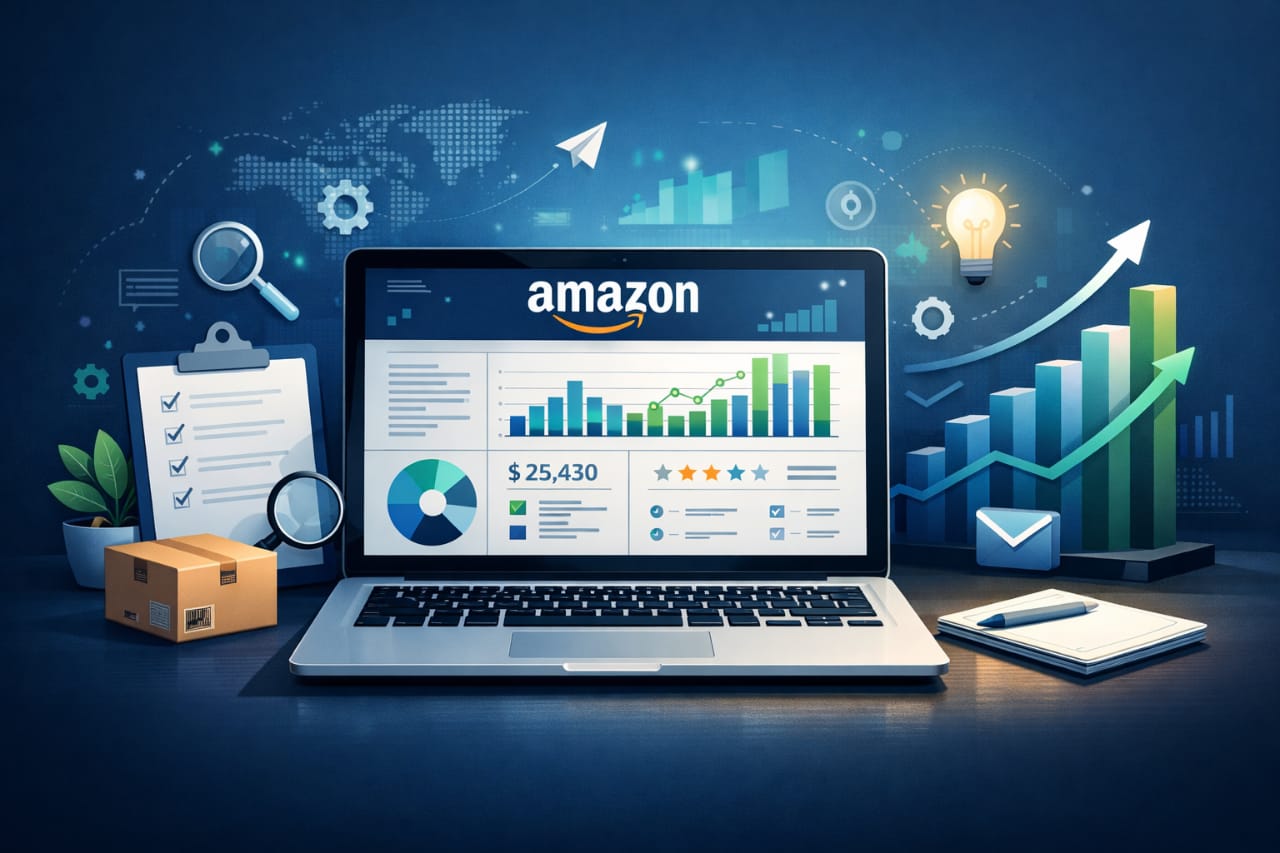
System First Selling How Elite Amazon Brands Scale Predictable
System First Selling How Elite Amazon Brands Scale Predictable
Introduction:
Selling on Amazon at an elite level is no longer about isolated tactics clever hacks or short term optimizations. The brands that scale predictable sustainable and profitable revenue follow a system first selling mindset. They design their Amazon business as an integrated operating system where strategy structure data execution and optimization work together continuously. This blog explores in depth how elite Amazon brands build and scale predictable growth using system first selling principles. It is written for advanced sellers brand owners and operators who want to move beyond trial and error into repeatable excellence.
Understanding System First Selling:
System first selling means designing the entire Amazon business before focusing on individual actions. Instead of asking what tactic should I try next elite brands ask how should my system behave when traffic increases competition changes or costs rise. A system is a set of interconnected processes governed by rules metrics and feedback loops. When built correctly the system produces consistent outcomes even as external variables change.
On Amazon this includes product selection supply chain pricing advertising listing optimization customer experience inventory planning and financial management. Each component must be aligned with a clear growth objective and must communicate with the others through data.
Elite brands avoid reactive decision making. They invest time upfront to design workflows standard operating procedures and performance thresholds. This allows teams and automation tools to execute reliably at scale.
The Strategic Foundation of Predictable Scaling:
Predictable scaling starts with strategy not execution. Elite Amazon brands define their positioning before launching or expanding. This includes category selection brand promise target customer profile and long term expansion roadmap.
They do not chase every trending niche. Instead they select categories where demand depth margin structure and competitive dynamics support long term brand building. They analyze search volume stability review velocity brand concentration and price elasticity across multiple years of data.
Strategic clarity allows these brands to say no. They avoid products that cannot support advertising costs or operational complexity. Predictability comes from focus not from volume of experiments.
Product Selection as a System Not a Guess:
Elite brands treat product selection as a repeatable analytical process. They build scoring models that evaluate potential products across multiple weighted criteria.
Key inputs include:
Market demand consistency Competitive density and brand dominance Average selling price and contribution margin Advertising cost benchmarks Operational complexity and defect risk Supply chain scalability
Rather than relying on intuition each product must pass a defined threshold. This ensures that every launch strengthens the system rather than introducing risk.
Advanced brands also model second order effects. They evaluate how a new product will affect brand conversion rates advertising efficiency and repeat purchase behavior.
Discover how elite Amazon brands scale with predictable systems
Learn the system first selling approach used by top performing Amazon brands
Get Expert Amazon Growth SupportBrand Architecture and Catalog Design:
Predictable scaling requires intentional brand architecture. Elite Amazon brands design their catalogs to create internal traffic flow and cross conversion.
They plan parent child variations bundles and complementary products in advance. This allows advertising and organic ranking gains to benefit multiple ASINs simultaneously.
Brand consistency across titles images copy and A Plus content reinforces trust and improves conversion rates. This reduces reliance on aggressive discounting and lowers advertising cost per acquisition.
Catalog design also considers lifecycle stages. Launch growth maturity and expansion phases are mapped so that inventory advertising and pricing strategies adjust automatically as products evolve.
Listing Optimization as an Ongoing System:
Elite brands do not treat listing optimization as a one time task. They build a continuous optimization system driven by data and customer feedback.
Keyword research is refreshed regularly using search term reports category trends and competitor analysis. Listings are updated systematically to capture emerging demand without disrupting ranking stability.
Visual assets are tested using controlled experiments. Main images secondary images and A Plus modules are evaluated against conversion metrics. Copy is refined based on review language and customer questions.
This disciplined approach compounds over time leading to higher baseline conversion rates and more predictable sales performance.
Advertising Systems Built for Scale:
Advertising is where system first selling delivers the most leverage. Elite Amazon brands design advertising structures that scale efficiently rather than chaotically.
They separate campaigns by intent match type and lifecycle stage. Prospecting campaigns are isolated from defense and retargeting. This allows clean performance analysis and budget allocation.
Bid management follows rules based on target advertising cost of sale contribution margin and inventory levels. Automation tools are configured with clear guardrails rather than open ended optimization.
Advanced brands use search term harvesting systems that continuously identify converting queries and route them into exact match campaigns. Poor performing terms are suppressed systematically.
The result is stable advertising efficiency even as spend increases.
CORE SYSTEMS BEHIND PREDICTABLE AMAZON SCALING
DATA DRIVEN STRATEGY
Elite brands rely on performance data and forecasting models to guide every growth decision.
SYSTEM FIRST LAUNCHES
Product launches follow predefined systems ensuring stable ranking and controlled spend.
OPERATIONAL AUTOMATION
Automation handles repeatable tasks while teams focus on optimization and scale.
INVENTORY CONTROL
Forecast driven inventory planning prevents stockouts and cash flow stress.
ADVERTISING EFFICIENCY
Structured campaigns protect margins while scaling visibility.
CUSTOMER EXPERIENCE
High review quality and strong brand trust drive predictable conversions.
Data Infrastructure and Decision Frameworks:
Predictable scaling depends on reliable data. Elite brands invest early in data infrastructure that consolidates Amazon reports advertising data and financial metrics.
They define a single source of truth for key performance indicators. This includes contribution margin true profit advertising efficiency inventory turnover and cash flow.
Decision frameworks are built around these metrics. For example pricing changes are evaluated based on elasticity models not gut feelings. Advertising budget increases require margin protection thresholds.
Weekly and monthly review cadences ensure that deviations are identified early and corrected systematically.
Inventory Planning as a Growth Enabler:
Inventory is one of the most common causes of unpredictable growth. Elite brands treat inventory planning as a strategic system not a reactive task.
They forecast demand using trailing averages seasonality adjustments and promotional plans. Lead times safety stock and reorder points are calculated dynamically.
Inventory decisions are integrated with advertising and pricing. When stock is constrained advertising is throttled automatically. When excess inventory exists promotional levers are activated in a controlled manner.
This alignment prevents stockouts ranking loss and cash flow shocks.
Supply Chain Resilience and Cost Control:
Scaling predictably requires a resilient supply chain. Elite Amazon brands diversify suppliers validate manufacturing processes and negotiate cost structures proactively.
They model landed cost scenarios under different freight and currency conditions. This allows pricing and margin strategies to adapt without disruption.
Quality control is embedded into the system with inspection protocols and feedback loops from customer reviews and returns.
A stable supply chain reduces operational noise allowing the growth system to function smoothly.

Customer Experience as a Conversion Engine:
Elite brands view customer experience as a revenue driver not a support function. They design packaging inserts product instructions and post purchase messaging to reduce friction and increase satisfaction.
Customer questions and reviews are monitored systematically. Common issues trigger listing updates or product improvements.
High review quality and rating stability improve conversion rates and advertising performance creating a virtuous cycle of predictable growth.
Financial Modeling and Profit Predictability:
System first selling requires deep financial visibility. Elite brands build profit models at the ASIN and catalog level.
They track contribution margin after advertising fulfillment fees storage returns and overhead. This allows informed decisions about scaling spend or expanding product lines.
Cash flow forecasting ensures that growth does not outpace working capital. Financing options are evaluated strategically rather than reactively.
Profit predictability enables confident investment in marketing product development and talent.
Conclusion:
Elite Amazon brands do not scale by chasing tactics. They scale by designing systems that produce predictable outcomes. System first selling aligns strategy execution data and people into a cohesive growth engine. When built correctly this approach transforms Amazon from a volatile marketplace into a controllable and profitable channel.
What is the biggest difference between average and elite Amazon brands?
How long does it take to build a system first Amazon business?
Can small brands apply system first selling?
-
Mary
- December 17, 2025
- 6:57 pm
- Reading time 5 min
Recent Posts
- All Post
- Amazon Compliance
- Amazon FBA Guide
- amazon market analysis
- Amazon PPC
- Amazon Stock
- Amazon Tools
- Business Strategy
- Ecommerce News & Analysis
- Full Account Management Services
- Guide
- Guide 2025
- News
- News 2026
- PPC Services
- Prime day
- Stories
- Team Memebers
- Technology and Digital Services
- Top Agencies
- Top PPC tools
- Why we are Unique?

Get a Quick Solution
Need help fast? Our expert team is here to provide you with efficient and reliable solutions tailored to your needs. Don’t wait—reach out today!
Categories
- Amazon Compliance (5)
- Amazon FBA Guide (6)
- amazon market analysis (2)
- Amazon PPC (30)
- Amazon Stock (1)
- Amazon Tools (17)
- Business Strategy (12)
- Ecommerce News & Analysis (6)
- Full Account Management Services (106)
- Guide 2025 (20)
- News 2026 (16)
- PPC Services (58)
- Prime day (2)
- Technology and Digital Services (1)
- Top PPC tools (1)
- Why we are Unique? (11)
Subscribe for Growth Tips, Seller Hacks & eCom Wins