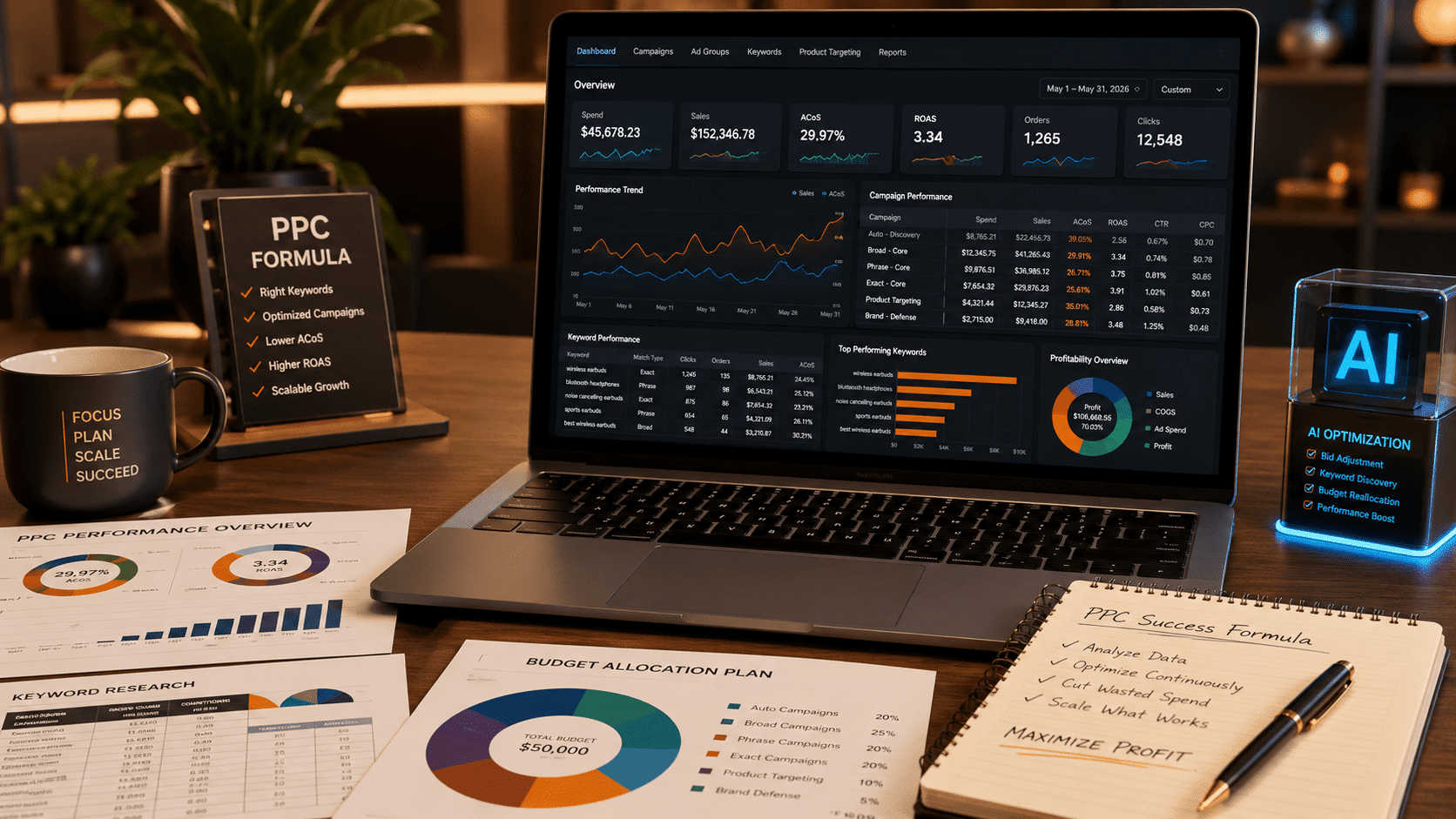
If you’ve just launched your first product on Amazon or have been selling for a while without running ads, you’re leaving money on the table. Amazon PPC (Pay-Per-Click) advertising is one of the most powerful tools available to sellers but it can feel overwhelming when you’re starting out. Budgets, bids, match types, campaign structures where do you even begin?
This Amazon PPC guide 2026 breaks everything down in plain language. By the end, you’ll know exactly how to set up your first campaign, choose the right bid strategy, and avoid the most common beginner mistakes.
What Is Amazon PPC?
Amazon PPC is an advertising model where you pay only when a shopper clicks your ad. Your products appear at the top of search results or on competitor product pages, giving you visibility that organic ranking alone can’t always deliver especially for new listings.
There are three main ad types on Amazon:
Sponsored Products: ads for individual listings, shown in search results and product pages
Sponsored Brands: banner ads that feature your brand logo and multiple products ads that reach shoppers both on and off Amazon
For beginners, Sponsored Products is where you should start. It’s the most straightforward, delivers the fastest results, and gives you the clearest data to work with.
Why PPC Matters More in 2026:
Organic visibility on Amazon has become increasingly competitive. With millions of sellers fighting for the same keywords, ranking on page one without ad support especially for a new listing is a slow process. PPC fills that gap immediately.
Beyond visibility, running PPC generates sales velocity, which directly signals Amazon’s algorithm that your product is relevant and converting. More clicks, more purchases, better organic rank. It’s a cycle that compounds over time.
If your listing is already optimized but not ranking, PPC is the accelerant you need. Make sure your listing foundation is solid before spending on ads a weak listing with active PPC is just an expensive way to lose money.
Understanding Campaign Types: Auto vs. Manual:
This is the first big decision every new advertiser faces and understanding the difference is essential.
Auto Campaign:
In an auto campaign, Amazon decides which search terms to show your ad for, based on your listing’s content. You set a budget and a default bid, and Amazon handles the targeting.
Pros:
– No keyword research needed to get started
– Excellent for discovering what terms shoppers actually use
– Great for new products with limited data
Cons:
– Less control over spend
– Can waste budget on irrelevant terms
– Requires regular review to add negative keywords
Manual Campaign:
In a manual campaign, you choose exactly which keywords or products to target. You control bids at the keyword level, giving you full precision.
There are two targeting types in manual campaigns:
– Keyword Targeting target specific search terms with broad, phrase, or exact match types
– Product Targeting target specific ASINs or categories
Pros:
– Full control over where your ads appear
– Ability to push budget toward high-converting terms
– Better for scaling and profitability
Cons:
– Requires keyword research upfront
– Takes more time to manage
Best use: Once you have data from your auto campaign, move top-performing keywords into a manual campaign with exact or phrase match for tighter control.
Keyword Match Types Explained:
Inside manual campaigns, match types determine how closely a shopper’s search query needs to match your keyword.
Broad Match your ad can show for searches that loosely relate to your , including synonyms and variations. It casts the widest net but may show for irrelevant queries.
Phrase Match your ad shows when the shopper’s search includes your keyword as a phrase, in the same order. More targeted than broad.
Exact Match your ad only shows when the search query matches your keyword exactly or very closely. Most precise, and usually the most efficient in terms of ACoS.
A beginner friendly approach: start with broad or phrase match in manual campaigns to gather data, then shift budget toward exact match once you’ve identified your best converters.
Setting Up Your First Campaign: Step by Step:
Step 1: Optimize Your Listing First
PPC drives traffic but traffic doesn’t convert if your listing isn’t ready. Make sure your title, bullet points, images, and A+ content are polished before spending a single dollar on ads.
Step 2: Set a Realistic Daily Budget
For beginners, start with $10–$20 per day per campaign. This gives Amazon enough data to work with without burning through your budget before you understand what’s working.
Step 3: Launch an Auto Campaign
Create an auto campaign targeting all four match types: close match, loose match, substitutes, and complements. Set a conservative default bid typically $0.50–$0.80 for most categories and let it run for two to four weeks.
Step 4: Analyze Your Search Term Report
After two weeks, download your search term report from Campaign Manager. Look for:
– Terms that generated sales add these to a manual campaign
– Terms that got clicks but no sales add as negative keywords
– Terms that are completely irrelevant negative keywords immediately
Step 5: Build Your Manual Campaign
Take your top-performing keywords and create a manual exact match campaign. Set bids based on what the data shows if a keyword converted profitably in auto, start your manual bid at a similar level.
Bid Strategy: How to Bid Without Overspending
Amazon offers three dynamic bidding options:
Dynamic Bids Down Only: Amazon lowers your bid when a click is less likely to convert. This is the safest option for beginners it limits overspend while still competing.
Dynamic Bids Up and Down: Amazon can raise your bid by up to 100% for placements likely to convert. Use this only when you have strong conversion data and want to be aggressive.
Fixed Bids: Your bid stays exactly as set, regardless of conversion likelihood. Not recommended for beginners you lose the protection of dynamic adjustments.
Recommended starting strategy: Use Dynamic Bids Down Only for your auto campaign and Fixed or Down Only for your manual campaign until you have at least 30 days of data.
Understanding ACoS:
ACoS (Advertising Cost of Sales) is your key performance metric:
ACoS = Ad Spend ÷ Ad Revenue × 100
If you spent $20 on ads and generated $100 in sales, your ACoS is 20%.
Your target ACoS depends on your profit margins. If your margin after fees and COGS is 35%, keep ACoS below that to stay profitable. Most beginners aim for 25–30% as a starting benchmark.
Common Beginner Mistakes to Avoid:
Running ads on an unoptimized listing:
PPC amplifies whatever your listing already is. Weak images or a vague title means ads will burn cash without converting.
Setting and forgetting:
PPC is not passive. Check campaigns weekly, add negative keywords, adjust bids on underperformers, and scale what’s working.
Targeting too broadly too soon:
Broad match in a new manual campaign can drain budget fast. Start with phrase or exact match for more control.
Ignoring negative keywords:
Without them, you’ll pay for clicks that never had a chance of converting.
Pausing campaigns too early:
New campaigns need time to gather data. Don’t judge performance in the first week. Give auto campaigns at least two weeks before making major decisions.
When to Scale Your PPC:
Once your campaigns have run for 30–60 days and you have clear data, look for these signals to scale:
– ACoS is at or below your target
– Several exact match keywords are converting consistently
– Your organic rank is improving
At this stage, increase budgets by 20–30% incrementally rather than doubling overnight. Sudden large budget jumps can disrupt Amazon’s delivery algorithm and temporarily spike your ACoS.
Final Thoughts:
Amazon PPC doesn’t have to be intimidating. Start simple — one auto campaign, one manual campaign, a clear budget, and a weekly review habit. The data will tell you what to do next.
The sellers who win with PPC aren’t necessarily the ones with the biggest budgets. They’re the ones who read their data, act on it consistently, and keep optimizing. That discipline compounds over