How to Lower Your ACOS on Amazon Without Losing Sales
The Ultimate Guide to Maximizing Your Sales and Amazon Account Performance
If you are an Amazon seller running Sponsored Products campaigns, you already know the pain: your “ACOS (Advertising Cost of Sale)” is eating into your margins, but every time you try to cut spend, your sales take a hit too. It feels like a trap with no way out.
The good news? Lowering your ACOS without sacrificing sales volume is absolutely possible but it requires a strategic, data-driven approach rather than simply slashing bids. In this guide, we break down the exact tactics that help Amazon sellers lower Amazon ACOS in 2026 while maintaining and even growing their revenue.
What Is ACOS and Why Does It Matter?
ACOS: stands for Advertising Cost of Sale. It is calculated as:
ACOS = (Total Ad Spend ÷ Total Ad Revenue) × 100
For example, if you spent $200 on ads and generated $1,000 in ad sales, your ACOS is 20%.
A high ACOS does not always mean your campaigns are failing context matters. A new product launch may justify a 60–80% ACOS for visibility. But for a mature, profitable listing, you should be targeting an ACOS at or below your break-even point.
Pro Tip: To find your break-even ACOS, subtract your total cost of goods (COGS) and Amazon fees from your selling price, then divide by the selling price. That percentage is the maximum ACOS you can afford without losing money.
- Start With a Campaign Profitability Audit:
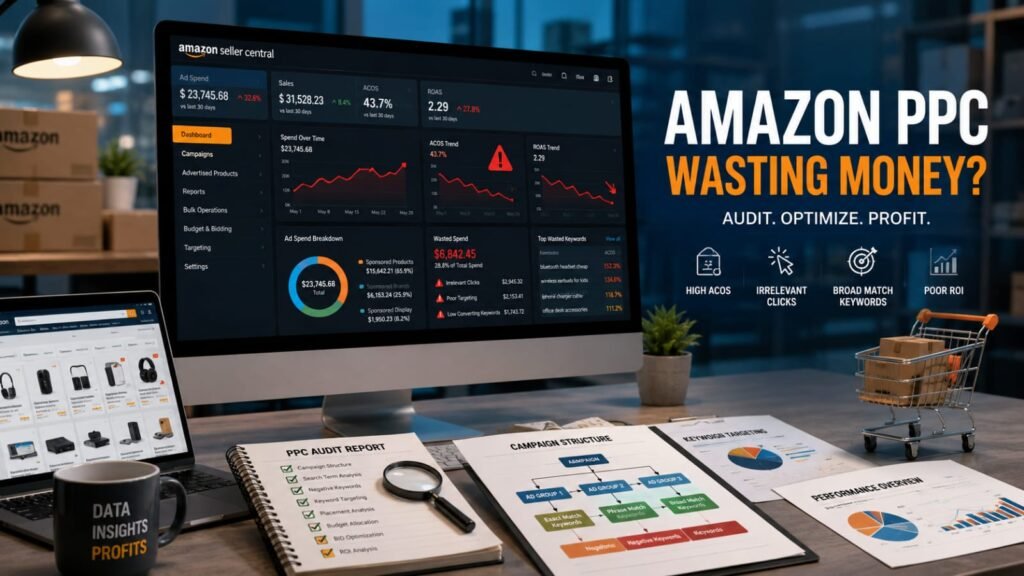
Before optimizing anything, you need to know what is actually working. Pull a Search Term Report from Amazon Seller Central and filter by the last 30–60 days. Look for:
– Keywords with high spend and zero or low conversions
– ASINs or search terms generating clicks but no sales
– Campaigns with ACOS significantly above your break-even threshold
– Ad groups mixing high-intent and low-intent keywords together
This audit gives you a clear picture of where your ad budget is leaking. Campaign profitability analysis is the foundation of any ACOS optimization strategy you cannot fix what you have not measured.
- Use Negative Keywords Aggressively:
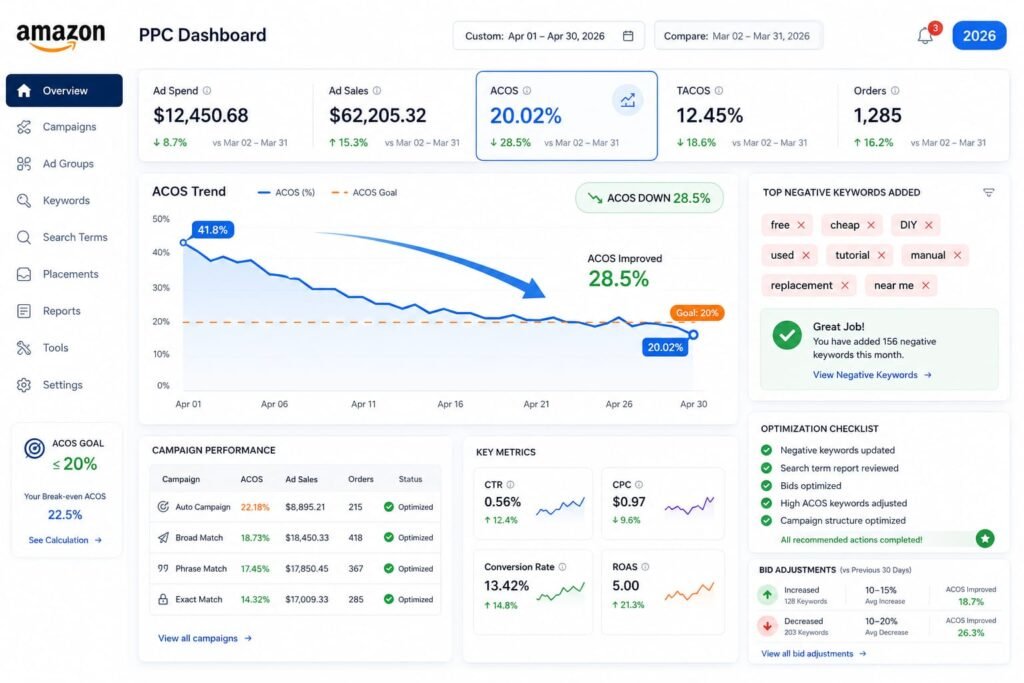
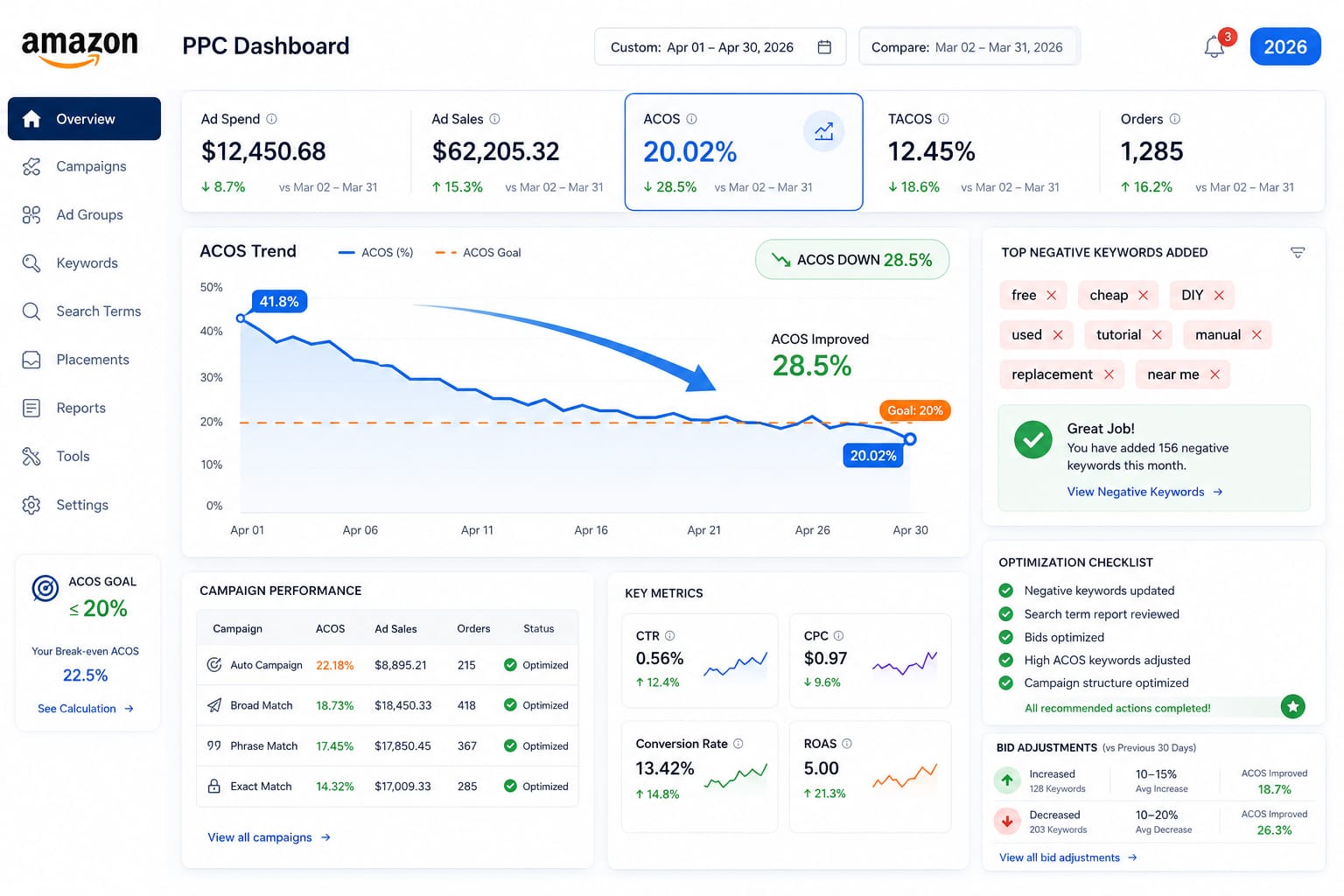
One of the fastest and most effective ways to lower Amazon ACOS is adding negative keywords to your campaigns. Negative keywords prevent your ads from appearing on irrelevant search queries that waste budget without converting.
How to Find Negative Keywords:
– Review your Search Term Report weekly and flag queries with 5+ clicks and no sales
– Add irrelevant broad terms (e.g., “free”, “DIY”, “used”) as negative exact or negative phrase matches
– Use negative keywords at the campaign level to block terms across all ad groups
– Create a master negative keyword list to apply across all campaigns.
Many sellers add negative keywords once and forget about them. Make it a weekly habit your Search Term Report will always surface new irrelevant queries as Amazon’s algorithm tests placements.
- Master Bid Adjustment for Better ROI:
Bid adjustment is arguably the most granular lever in Amazon PPC. Rather than cutting bids across the board (which tanks impressions and sales), make surgical adjustments at the keyword level.
- Bid Adjustment Best Practices:
– Reduce bids by 10–20% on keywords with ACOS above your target — not all at once
– Increase bids by 10–15% on keywords converting well below your target ACOS
– Use placement modifiers to reduce spend on Top of Search if your conversion rate there is poor
– Set portfolio-level bid limits to cap daily spend on underperforming campaigns
Amazon’s Dynamic Bids Down Only option is a good starting point for campaigns where you want to control ACOS more tightly. It allows Amazon to lower your bids in real time when a click is less likely to convert.
Important: Avoid making multiple bid changes at once. Change one variable at a time and wait at least 7–14 days before evaluating results. Amazon’s algorithm needs time to learn.
- Restructure Your Campaigns for Cleaner Data:
If your campaigns are a mix of broad, phrase, and exact match types all in one ad group, you are flying blind. One of the most impactful ACOS optimization strategies is separating match types into dedicated campaigns.
Recommended Campaign Structure:
- Auto Campaign: For discovery and harvesting new converting search terms
- Broad Match Campaign: For expanding reach with lookalike traffic
- Phrase Match Campaign: For balanced volume and relevance
- Exact Match Campaign: For your proven, high-converting keywords with tighter bids
Once you identify a profitable search term in your auto or broad campaign, move it into your exact match campaign with a competitive bid and add it as a negative in the original campaign. This is called the “Search Term Harvesting” method and it is the backbone of profitable PPC management.
- Optimize Your Listing Before Increasing Bids:
Here is a truth many PPC managers overlook: a low conversion rate is an ACOS problem, not just a PPC problem. If 100 shoppers click your ad and only 2 buy, your ACOS will always be high regardless of how low your bids are.
Before investing more in ads, make sure your listing is conversion-optimized:
– Main image is high-quality, zoomable, and shows the product clearly
– Title includes your primary keyword naturally in the first 80 characters
– Bullet points address the top 3 customer pain points above the fold
– A+ Content or EBC is active to increase conversion rate by 5–10%
– Reviews are above 4.2 stars with at least 15+ ratings
A well-optimized listing converts more of the traffic you are already paying for reducing your effective ACOS without touching your bids. This is the intersection of SEO and PPC, and it is where the biggest ROI improvements happen.
Common ACOS Mistakes to Avoid:
- Cutting bids on all keywords at once hurts ranking and sales velocity
- Ignoring match type segmentation makes it impossible to identify what is actually converting
- Never reviewing the Search Term Report the single biggest source of wasted spen
- Optimizing ACOS in isolation without looking at organic rank and TACOS
- Setting and forgetting campaigns Amazon PPC requires weekly attention to stay profitable
Final Thoughts:
Lowering your Amazon ACOS in 2026 is not about spending less it is about spending smarter. By combining rigorous negative keyword management, surgical bid adjustments, cleaner campaign structures, and listing optimization, you can build campaigns that are both profitable and scalable.
The sellers who win on Amazon PPC are not the ones with the biggest budgets. They are the ones with the best data habits and the discipline to act on them consistently.
If you are ready to stop guessing and start scaling profitably,We specialize in turning underperforming Amazon PPC campaigns into consistent revenue engines.
-
Mary
- May 18, 2026
- 7:58 pm
- Reading time 7 min
Recent Posts
- All Post
- Amazon Compliance
- Amazon FBA Guide
- amazon market analysis
- Amazon PPC
- Amazon SEO
- Amazon Stock
- Amazon Tools
- Business Strategy
- eCommerce
- Ecommerce News & Analysis
- Full Account Management Services
- Guide
- Guide 2025
- News
- News 2026
- PPC Services
- Prime day
- Stories
- Team Memebers
- Technology and Digital Services
- Top Agencies
- Top PPC tools
- Why we are Unique?
Get a Quick Solution
Need help fast? Our expert team is here to provide you with efficient and reliable solutions tailored to your needs. Don’t wait—reach out today!
Categories
- Amazon Compliance (5)
- Amazon FBA Guide (7)
- amazon market analysis (2)
- Amazon PPC (34)
- Amazon SEO (2)
- Amazon Stock (1)
- Amazon Tools (17)
- Business Strategy (12)
- eCommerce (2)
- Ecommerce News & Analysis (6)
- Full Account Management Services (105)
- Guide (1)
- Guide 2025 (20)
- News 2026 (16)
- PPC Services (58)
- Prime day (2)
- Technology and Digital Services (1)
- Top PPC tools (1)
- Why we are Unique? (11)
Subscribe for Growth Tips, Seller Hacks & eCom Wins