Amazon FBA
Amazon 2027 FBA Fee Changes: A Per-SKU Action Plan Before Jan 15 and Feb 1
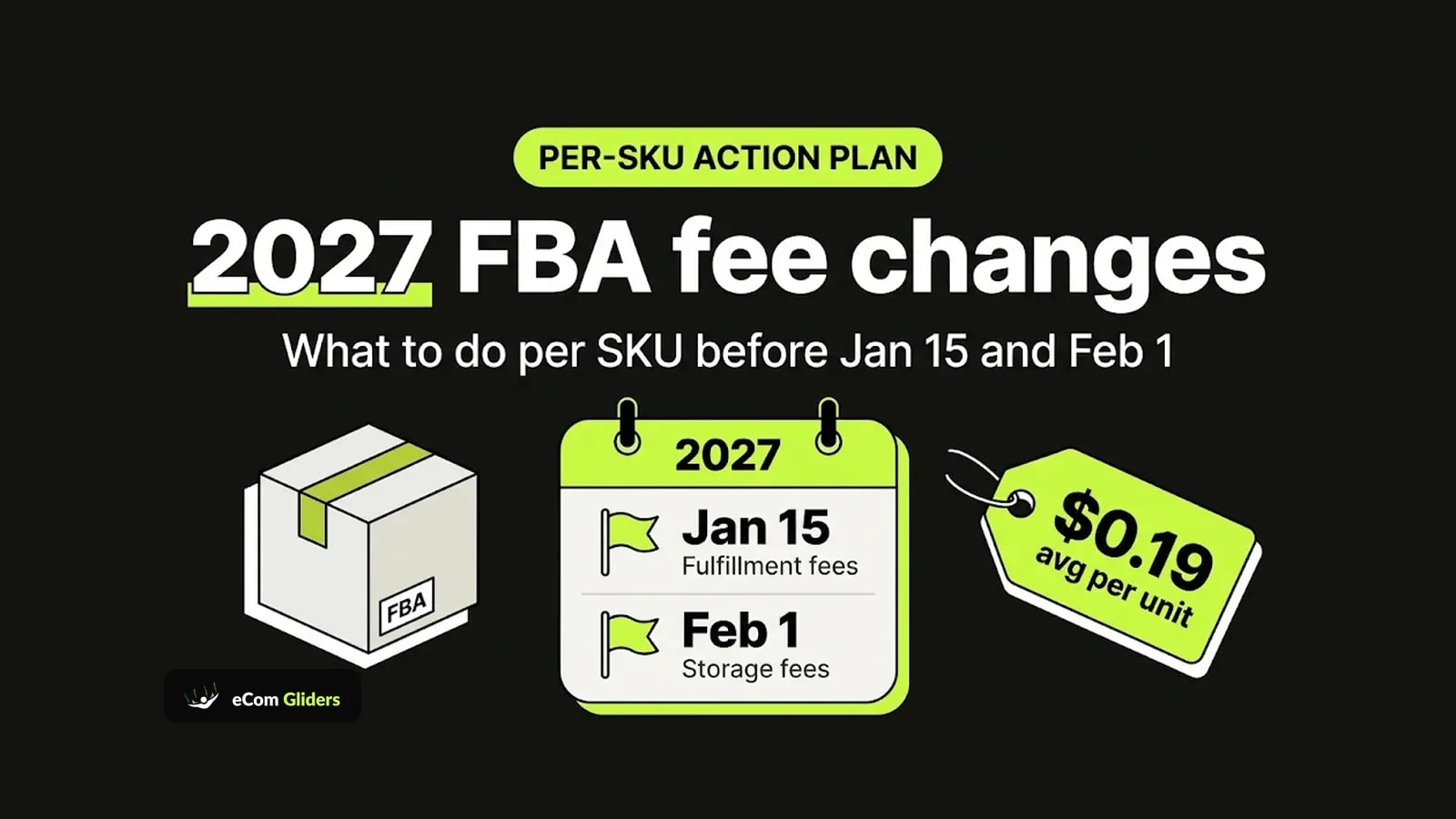
Amazon confirmed an average $0.19 per unit FBA fulfillment fee increase from January 15, 2027, plus storage and low-inventory-level fee changes from February 1. Here is what is confirmed and a...
- November 17, 2026
- 9 min read
- Mary
Key takeaways
- What Amazon has confirmed for 2027 (and when)
- Why the $0.19 average can mislead you
- The per-SKU decision tree: four questions, four actions
Table of contents
Amazon says US FBA fulfillment fees will rise by an average of $0.19 per unit sold, about 0.8% of the average selling price, with most changes taking effect on January 15, 2027. On February 1, 2027, storage changes too: the storage utilization surcharge goes away, the aged inventory surcharge and monthly storage fee merge into one age-based rate, and the low-inventory-level fee applies only when you hold less than 28 days of supply. That is the short version from Amazon's 2027 fee announcement.
The average hides big differences between products. A $0.19 shift means little on a $60 item and a lot on a $9 item with a thin margin. This guide separates what Amazon has confirmed from what you still need to check in Seller Central, then gives you a four-question check to run on each SKU so you leave with a specific action, not just a list of changes.
Last checked: November 17, 2026.
What Amazon has confirmed for 2027 (and when)
Amazon has confirmed an average fulfillment fee increase starting January 15, 2027, and three storage and inventory fee changes starting February 1, 2027. Here is what the announcement states directly.
| Change | Effective date | What it means for you |
|---|---|---|
| FBA fulfillment fees rise by an average of $0.19 per unit (about 0.8% of average selling price) | January 15, 2027 | Some SKUs go up more, some less, and some fees go down |
| Storage utilization surcharge eliminated | February 1, 2027 | One less surcharge to track on storage |
| Aged inventory surcharge and monthly storage combined into one age-based monthly rate | February 1, 2027 | Flat or lower for stock that turns in under 6 months, higher for aged stock |
| Low-inventory-level fee applies only below 28 days of supply | February 1, 2027 | Measured on actual shipments in the 4 weeks before and 4 weeks after the assessment date |
Source: Amazon's 2027 fee announcement, published November 5, 2026.
Amazon also says the FBA fuel and logistics surcharge it introduced in April 2026 stays unchanged for now and remains under review. The announcement does not restate the percentage, so check the current figure in Seller Central rather than relying on a number you saw elsewhere.
What changes on January 15, 2027
Fulfillment fees change. Amazon describes the increase as an average of $0.19 per unit sold, roughly 0.8% of average selling price. It also says impact varies by product, size and price, and that some fees will go up while others go down. In other words, your catalog will not move by a uniform amount.
What changes on February 1, 2027
Three things change on the storage and inventory side:
- Storage utilization surcharge is removed. Amazon says it is being eliminated.
- Aged inventory is folded into monthly storage. Instead of a separate aged inventory surcharge on top of monthly storage, there will be a single age-based monthly storage rate. Amazon says it will be flat or lower for inventory that turns in under 6 months and higher for aged inventory.
- The low-inventory-level fee uses a new test. It applies only when inventory is below 28 days of supply, based on actual shipments in the 4 weeks before and the 4 weeks after the assessment date. This replaces the older method based on trailing 30-day and 90-day sales.
What Amazon says is affected but did not price in the announcement
The announcement names several other areas that are part of the 2027 update but does not list figures for them in the post itself:
- Small standard-size and large standard-size items
- Items priced above $50
- Buy X Get Y promotions
- Multichannel Fulfillment
- Amazon Warehousing and Distribution
For any of these, check the full rate table in Seller Central. Some third-party sites have published tier-level numbers, but we could not verify them against Amazon's own summary, so confirm each figure in Seller Central before you build a pricing decision on it.
Why the $0.19 average can mislead you
The $0.19 figure is an average across all US FBA units, so it tells you little about any single SKU. Amazon itself says the impact depends on product, size and price, and that some fees fall while others rise.
The average has also drawn pushback. In Amazon's Seller Forums announcement thread, some sellers say the increase they expect on their own items is higher than $0.19. Those are individual estimates, not Amazon data, but they show the risk: a catalog-level average can hide a much larger change on your best-selling SKU.
Two products can see the same dollar change and very different outcomes. A small increase on a low-price item eats a bigger share of its margin than the same increase on a higher-price item. That is why the decision should be made SKU by SKU.
The per-SKU decision tree: four questions, four actions
Run each important SKU through four questions. Each "yes" points to one action. A SKU can trigger more than one.
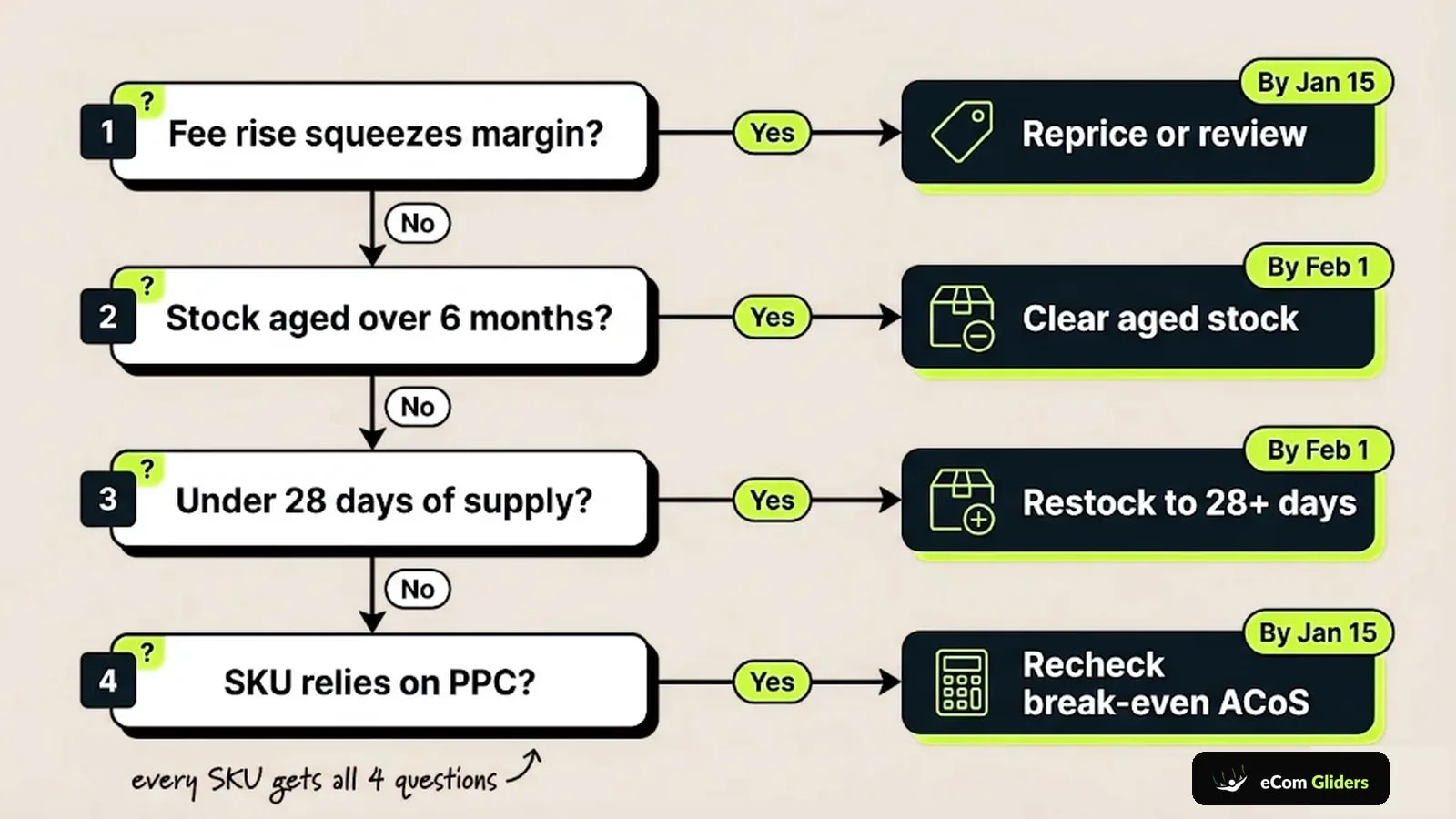
Question 1: Does the new fulfillment fee squeeze this SKU's margin?
Compare the new fulfillment fee for the SKU with the current one, then recalculate your margin at today's price. If the margin drops below what you need to cover ads, returns and overhead, the action is to reprice or review the SKU.
Reprice carefully. In the same forum thread, some sellers said they worry that raising prices to absorb fees could trigger automated price checks that suppress offers or cost them the Buy Box. Small, tested changes are safer than one large jump, and for some SKUs the better answer is reviewing packaging, bundling or whether the item still belongs in FBA. There is no single right move, and no price change guarantees the same sales volume.
Question 2: Has any of this SKU's stock sat in a fulfillment center for 6 months or longer?
Under the new age-based storage rate, Amazon says inventory that turns in under 6 months gets a flat or lower rate, while aged inventory pays more. If a SKU has units approaching or past that point, the action is to clear, remove or liquidate aged units before February 1, 2027.
Start with your inventory age data in Seller Central, sort by the oldest units, and decide for each one whether a promotion, a removal order or liquidation makes the most sense. The goal is to avoid carrying slow stock into the new rate structure without a plan.
Question 3: Is this SKU's days of supply below 28?
From February 1, 2027, the low-inventory-level fee applies only when inventory falls below 28 days of supply. Amazon measures this on actual shipments in the 4 weeks before and the 4 weeks after the assessment date. If a SKU regularly runs lean, the action is to restock to 28 or more days of supply.
This rewards steady replenishment over last-minute top-ups. If stockouts and rushed shipments are a regular problem, our guide to FBA inventory management that avoids stockouts walks through a more stable setup. Because the measurement looks both backward and forward, it also helps to forecast demand for the 8 weeks around each check rather than planning only on last month's sales.
Question 4: Does this SKU rely on PPC?
If a meaningful share of the SKU's sales comes from Sponsored Products or other ads, the action is to recalculate break-even ACoS. A higher fulfillment fee lowers the most you can spend on ads before a sale loses money. The next section shows how.
Quick summary
| Question | Signal to check | Action | Deadline |
|---|---|---|---|
| Does the new fee squeeze margin? | Margin at current price after new fee | Reprice or review | Before January 15, 2027 |
| Stock aged 6+ months? | Inventory age report | Clear, remove or liquidate aged units | Before February 1, 2027 |
| Days of supply below 28? | Days of supply and inbound plan | Restock to 28+ days | Before February 1, 2027 |
| Relies on PPC? | Ad share of sales, current target ACoS | Recalculate break-even ACoS, adjust bids | Before January 15, 2027 |
How a fee increase changes your break-even ACoS
Your break-even ACoS equals your profit margin before ad spend. Any fee increase cuts that margin, so it also cuts the highest ACoS you can run without losing money on each sale.
The formula is:
Break-even ACoS = (selling price minus all non-ad costs) ÷ selling price
Non-ad costs include product cost, inbound shipping, the FBA fulfillment fee, the referral fee, storage and any other per-unit costs you track.
Illustrative example (hypothetical SKU, round numbers, not Amazon rates):
- Selling price: $30.00
- Product and inbound cost: $8.00
- FBA fulfillment fee: $6.00
- Referral fee: $4.50
- Storage and other per-unit costs: $1.50
- Total non-ad costs: $20.00
- Profit before ads: $10.00
- Break-even ACoS: $10.00 ÷ $30.00 = about 33.3%
Now assume the fulfillment fee on this made-up SKU rises by $0.50, to $6.50. Total non-ad costs become $20.50, profit before ads drops to $9.50, and break-even ACoS falls to $9.50 ÷ $30.00 = about 31.7%.
If your campaigns for this SKU were running near 33% ACoS, they would move from roughly break-even to losing money on each ad-driven sale, even though nothing changed in your ad account. The action is to recalculate break-even ACoS with your real new fees for each affected SKU and update target ACoS and bids before January 15, 2027.
Timeline: what to do before January 15 and February 1
You have two deadlines, and each one calls for different work. Fulfillment fee and PPC changes should be done before January 15, 2027. Storage and inventory moves should be done before February 1, 2027.
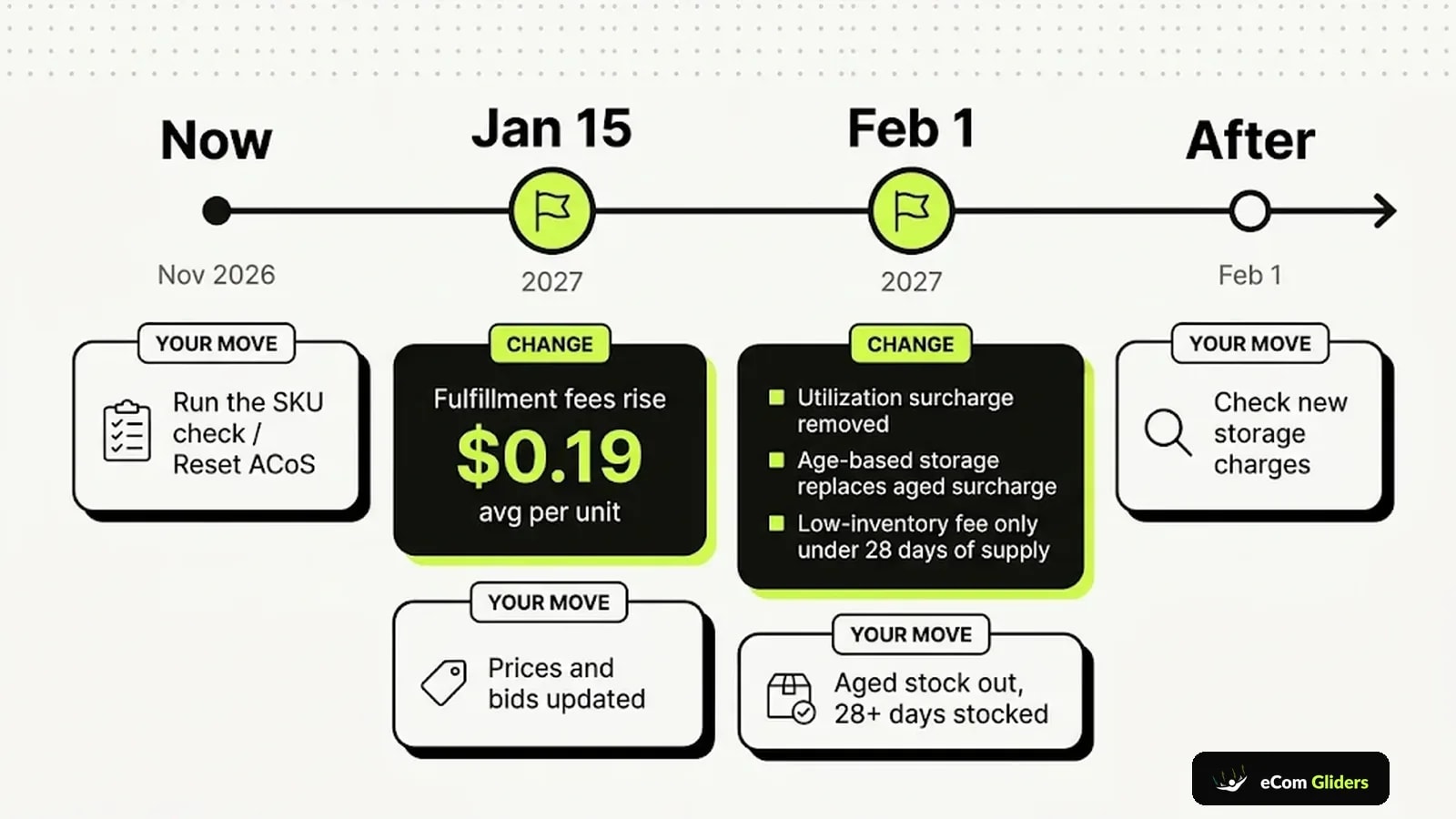
Now through January 14, 2027
- Pull your top SKUs by units and by revenue.
- Run each through the four questions above.
- Reprice or review SKUs where the new fulfillment fee squeezes margin.
- Recalculate break-even ACoS and reset targets and bids for ad-reliant SKUs.
- Build a removal, promotion or liquidation plan for aged units.
January 15 to January 31, 2027
- Confirm new fulfillment fees on your first orders match what you modeled.
- Finish clearing or scheduling removal of aged stock.
- Make sure replenishment keeps each key SKU at 28 or more days of supply.
From February 1, 2027
- Check your first storage charges under the age-based rate.
- Watch for any low-inventory-level fees and compare them with your shipment history.
- Revisit pricing and ad targets once you have real fee data, not just estimates.
How to see your own SKU-level impact in Seller Central
Amazon points sellers to three tools inside Seller Central for estimating their own impact: the Fee Change Comparison dashboard, Profit Analytics and the Revenue Calculator. All three require a Seller Central login.
A practical way to use them:
- Export your top SKUs by units sold, since fulfillment fees are charged per unit.
- Open the Fee Change Comparison dashboard, which Amazon points sellers to for estimating impact, and review each of those SKUs.
- Check margin by SKU in Profit Analytics, or in whichever of the profit analytics tools you already use.
- Use the Revenue Calculator to test a price change before you make it live.
- Feed the results into the four-question decision tree and record one action per SKU.
Start with the SKUs that drive most of your units. A long tail of slow sellers matters for aged inventory, but because fulfillment fees are charged per unit, the change adds up fastest on your highest-volume SKUs.
Checklist before January 15
- Read Amazon's announcement and the full fee summary in Seller Central.
- Note the current fuel and logistics surcharge percentage shown in Seller Central.
- List your top SKUs by units and revenue.
- Compare old and new fulfillment fees for each of those SKUs.
- Recalculate margin and break-even ACoS with the new fees.
- Update target ACoS and bids for ad-reliant SKUs.
- Flag every SKU with units at or near 6 months of age.
- Set reorder points so key SKUs stay at 28 or more days of supply.
Frequently asked questions
Are Amazon referral fees changing in 2027?
Amazon's announcement post does not list referral fee changes for 2027, even though its title mentions referral fees. Check the full 2027 fee summary in Seller Central for any category-specific referral changes before you finalize pricing.
Is the storage utilization surcharge going away?
Yes. Amazon says the storage utilization surcharge will be eliminated starting February 1, 2027.
Get a second look at your SKU list
Fee changes like these touch pricing, inventory and advertising at the same time, so they are easier to manage as part of ongoing Amazon account management than as a one-off fix.
Want a second pair of eyes on your SKU list before January 15? Request a free audit and we will review fee exposure, aged inventory and break-even ACoS for your top ASINs.
About the author
Mary
Content Specialist
Mary writes practical Amazon seller guides covering PPC, SEO, listing optimization, and account management.
Keep reading