Key takeaways
- The short answer: what "best" means for your brand
- Decide what you actually need first
- Where to find vetted Amazon agencies
Table of contents
The best Amazon agency for a US brand is the one that fits your stage, can be checked in Amazon's own directories, tells you exactly who will touch your account, works through user permissions instead of your login, ties its fees to results you can see in your own reports, and lets you leave with your data. The process: shortlist, interview, score, then sign a short first agreement.
A quick disclosure: eCom Gliders is an Amazon agency. Everything below is written so you can apply it to any agency you talk to, including us.
The short answer: what "best" means for your brand
There is no single best Amazon agency, only the best fit for your catalog, budget and gaps. In practice, "best" comes down to four things you can check before you sign:
- Fit: the agency already does the specific work you need, in a category like yours.
- Verifiability: its claims hold up when you look it up on Amazon's own platforms.
- Control: you keep ownership of your Seller Central account, ad accounts, creative files and data.
- Alignment: the way it charges rewards the outcomes you care about, not just more spend.
Decide what you actually need first
Before you compare agencies, decide what kind of help solves your problem. Many disappointing hires start with buying a full-service package when the real gap was ads, or the reverse.
| Your situation | Likely fit | Why |
|---|---|---|
| Pre-launch or very small catalog, tight budget | DIY with tools, or a vetted freelancer for one task | Agency retainers can outweigh the value at this stage |
| Listings and operations are fine, ads are the gap | PPC specialist | Narrow scope, easier to measure |
| Catalog issues, cases, account health and inventory eat your week | Account management | Day-to-day ownership of Seller Central work |
| Scaling brand needing ads, listings, creative and operations coordinated | full-service Amazon agency support | One accountable team across connected workstreams |
These are general patterns, not rules. If you are torn between building in-house and hiring out, compare the full cost of each option. It helps to weigh agency fees against the hidden costs of doing PPC yourself, including your own time and tools.
Where to find vetted Amazon agencies
Start your shortlist on Amazon's own platforms, then verify anything an agency says about its relationship with Amazon.
Amazon Service Provider Network
The Amazon Service Provider Network lists third-party providers for services such as account management, advertising, imaging and compliance. According to Amazon, providers are vetted and their performance is monitored, but Amazon lists them for information only and does not endorse them. Any reference prices shown are not binding, and you contract with the provider directly.
Treat an SPN listing as a starting filter, not proof of quality.
Amazon Ads partner directory
If an agency says it is an Amazon Ads partner, look it up in the Amazon Ads partner directory yourself. Amazon Ads announced two partner status tiers, verified and advanced, in April 2022. Check an agency's current status in the directory at the time you hire rather than trusting a logo in a pitch deck.
How to read badges and marketing claims
Amazon Ads also publishes marketing guidelines for agencies and tool providers. As we read them in November 2026, they limit how partner status may be described and discourage claims that imply Amazon endorsement or guaranteed advertising results. Check the current guidelines yourself, but in practice, if a pitch promises a guaranteed ACoS, ROAS or ranking, or calls itself "Amazon certified" or "the #1 Amazon agency" in a way that implies Amazon's backing, treat that as a warning sign rather than a selling point.
If you want a starting point beyond the directories, see our shortlist of Amazon agencies for FBA brands. Whatever list you start from, run every finalist through the scorecard below.
12 questions to ask before you sign
Ask every agency the same questions so you can compare answers. Each includes what a strong answer usually sounds like.
Fit and team
- Who will actually work on my account day to day? A good answer names roles, not just a sales contact, and tells you how many accounts each manager handles.
- Is the work done in-house or subcontracted? A good answer is direct. If any work is outsourced, they say what, to whom, and how access is controlled.
- What experience do you have in my category and business model? A good answer covers similar products, FBA or FBM, price points and seasonality.
Access and data
- How will you access my account without my login? A good answer: you add the agency as a user with only the permissions it needs in Seller Central, and link it to your Amazon Ads account, so no one shares your password.
- Who owns the ad accounts, creative files, copy and reports? A good answer: you do, in writing, and you can export them at any time.
- What other seller accounts does the person accessing mine touch, and how do you keep them separate? A good answer shows they understand related-account risk and use unique, named users for each client.
Strategy and reporting
- Which KPIs will you report beyond ACoS? A good answer includes TACoS (ad spend as a share of total sales), total and organic sales trends, and contribution profit, not ad metrics alone.
- How often will I get reports, and can I see the raw data? A good answer gives a fixed cadence and confirms the numbers can be checked against your own Seller Central and Amazon Ads reports.
- What would you change in my account in the first 30 days, and why? A good answer is specific to your catalog after an audit, not a generic playbook.
Commercials and exit
- How do you charge, and what is not included? A good answer lists the fee model plus every extra: onboarding, creative production, tools, and any minimum ad spend.
- What is the term and notice period? A good answer offers a reasonable notice period and no lock-in that survives poor performance.
- What happens when we part ways? A good answer describes a handover: exports, files, access removal and a final report.
Red flags that should end the conversation
- They ask for your Seller Central password or two-step verification codes. Amazon staff on the Seller Forums have repeatedly advised sellers not to share credentials and to grant access through user permissions instead.
- One login or email is shared across many client accounts. In one seller's report on the Amazon Seller Forums, an agency user (same email) was also tied to another seller's account. When that account was suspended, the seller's own account was suspended as related.
- Long lock-in or non-refundable annual prepayment. One seller in Amazon's Seller Forums described prepaying a full year to an ads provider, seeing sales decline and being refused a partial refund.
- Guaranteed ACoS, ROAS or rankings. No one controls Amazon's auction or algorithm.
- Any hint of review manipulation or other tactics that break Amazon's rules. The risk lands on your account, not theirs.
- Agency-owned ad accounts, dashboards or creative you cannot export. If you cannot take it with you, you do not fully own it.
- Ad spend rising while total and organic sales fall, with no clear explanation. A multi-marketplace seller in Amazon's Seller Forums described this pattern with more than one agency.
Amazon agency pricing models compared
Most Amazon agencies use one of four pricing models. None is automatically better; what matters is the incentive each creates and whether the scope is clear.
| Model | How it works | Incentive it creates | Watch for |
|---|---|---|---|
| Flat retainer | Fixed monthly fee for a defined scope | Predictable cost; effort is not tied to spend | Vague scope, slow response once signed |
| Percentage of sales | Fee based on revenue in managed channels | Shared interest in growth | Paying for sales you would have made anyway; unclear baseline |
| Percentage of ad spend | Fee based on monthly advertising budget | Can reward higher spend even when it is not profitable | Spend growth without matching profit or TACoS improvement |
| Hybrid | Base fee plus a variable or performance component | Balances stability and accountability | Complicated formulas; bonuses tied to metrics you cannot verify |
Whatever model you choose, ask about costs that sit outside the headline fee:
- Onboarding or setup charges
- Creative work such as A+ Content, images and video
- Software or tool pass-through costs
- Minimum monthly ad spend requirements
- Early termination fees
Ask for a written quote listing all of them, then compare total cost for the same scope.
Contract terms to insist on
A good contract protects both sides but never traps you. Look for:
- A short initial term or a trial scope, so both sides can confirm fit before a longer commitment.
- A clear notice period and no non-refundable prepayment that survives termination.
- Ownership language stating that creative files, copy, campaign structures and reports belong to you.
- Defined deliverables and reporting cadence, so "management" has a measurable meaning.
- Access and confidentiality terms, including how users are created and removed.
- An offboarding duty, requiring a handover and final exports.
- No subcontracting without your consent.
This is general guidance, not legal advice. Have a lawyer review any agreement before you sign it.
Onboard safely: give access without giving away your account
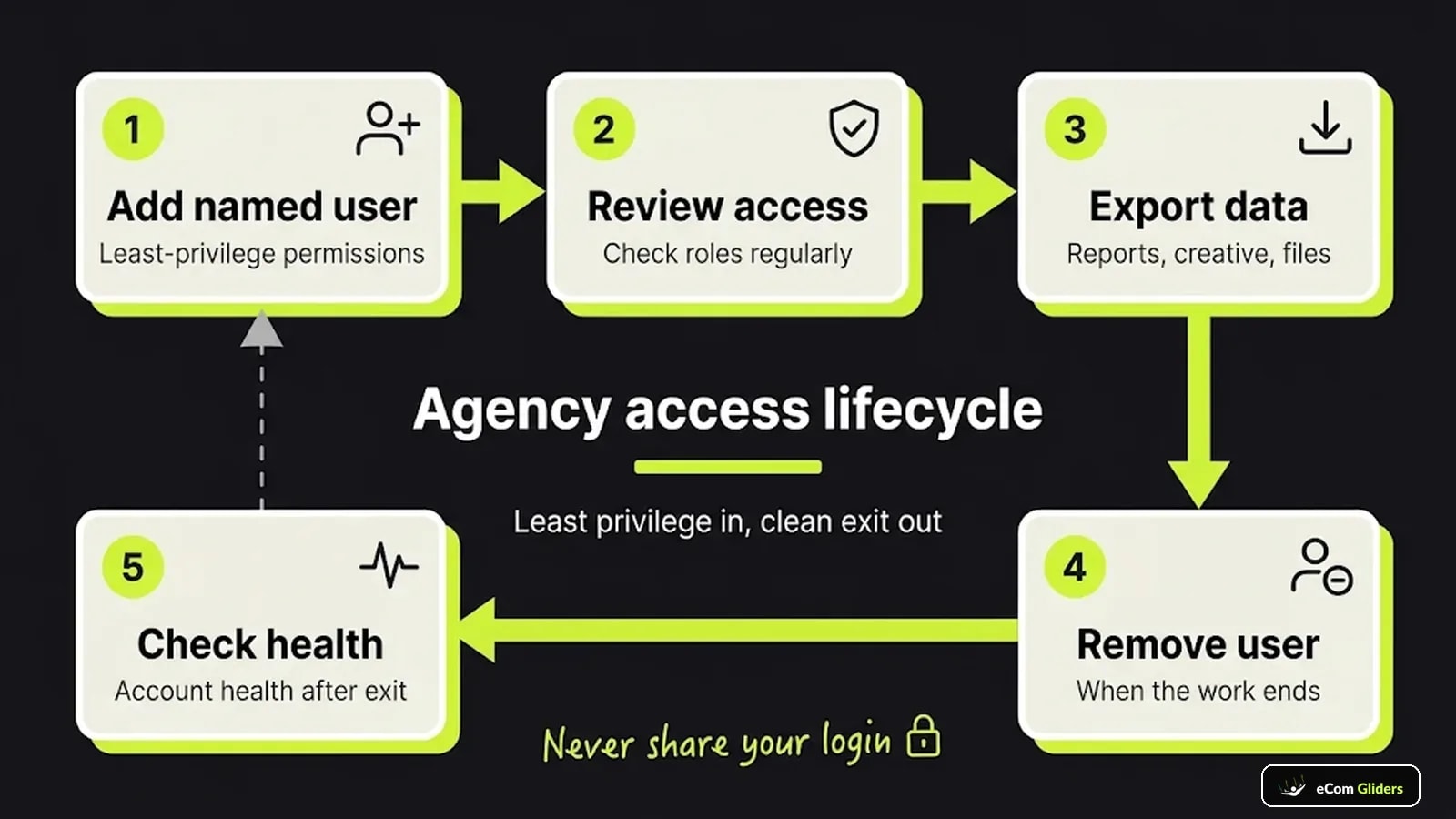
Give an agency only the access it needs, through named users, and keep the account owner role yourself.
In Seller Central, add the agency as a user with only the permissions it needs, and do not share your login. Amazon staff replies in the Seller Forums give the same advice and also suggest reviewing and removing users regularly. Menus change, so follow the current help pages inside your account.
In Amazon Ads, agencies can work through a manager account linked to your advertising account, so they do not need your personal login. Make sure your business remains the owner of the advertising account.
Keep ownership roles with your business. The primary Seller Central account and your Brand Registry rights should stay with you or a trusted employee, never with an outside provider.
What the first 90 days should look like
These milestones are a suggested framework, not a guarantee, and results depend on your category, budget and starting point.
- Days 1 to 30: account audit, access set up correctly, baseline numbers recorded, and goals agreed in writing.
- Days 31 to 60: structural fixes shipped, such as campaign restructuring, listing improvements and catalog cleanup, plus the first full report you can read and question.
- Days 61 to 90: trends compared against the baseline on the KPIs you agreed. This is your decision point: continue, adjust scope or exit.
If you reach day 90 without a written baseline, you have no fair way to judge the work.
Your exit plan: offboarding checklist
Plan the exit before you sign, then follow it in order.
- Export campaign structures, search term reports and performance reports.
- Collect all creative and source files: images, A+ Content, video and copy.
- Confirm you own every ad account, tool subscription and dashboard, or transfer them.
- Remove agency users and any third-party app access you no longer need.
- Change any credentials that were ever shared, even briefly.
- Check your Brand Registry roles and account health after access is removed.
That last step matters. Sellers in Amazon's Seller Forums have reported access surprises here. In one case, Brand Registry access was revoked around the time agency users were removed during troubleshooting, and it was later reinstated. The cause was not established, but it is a good reason to check roles during any access change.
Agency scorecard: compare finalists side by side
Score each finalist from 1 to 5 on every criterion, multiply each score by its weight, and add up the results. The total is a score out of 5. The weights below are a suggestion, so adjust them to match what matters most for your brand.
The scores in this table are a worked example for three made-up agencies, not ratings of real companies. Replace them with your own scores after each interview.
| Criterion | Suggested weight | Agency A (example) | Agency B (example) | Agency C (example) |
|---|---|---|---|---|
| Fit for your stage and category | 15% | 5 | 3 | 4 |
| Claims verifiable in Amazon directories | 10% | 4 | 3 | 5 |
| Access method (named users, no shared login) | 15% | 5 | 2 | 4 |
| You own data, ad accounts and creative | 15% | 5 | 2 | 4 |
| Team transparency (who does the work) | 10% | 3 | 4 | 4 |
| KPI and reporting quality | 10% | 4 | 3 | 4 |
| Pricing model aligned with your goals | 10% | 3 | 5 | 4 |
| Contract flexibility and notice period | 5% | 2 | 5 | 4 |
| Clear exit and handover terms | 5% | 3 | 4 | 5 |
| References in a similar category | 5% | 4 | 3 | 4 |
| Weighted total (out of 5) | 100% | 4.10 | 3.15 | 4.15 |
How to read the example: Agency C wins with 4.15 because it scores well everywhere. Agency A comes close at 4.10 with the best account control but a rigid contract. Agency B has the lowest total at 3.15, but the bigger problem is that it scores 2 on both access method and data ownership. Under the rule below, that takes it off the list even if its price looks attractive.
To check the math, Agency A's first row adds 15% x 5 = 0.75 points, its second row adds 10% x 4 = 0.40 points, and so on down the column.
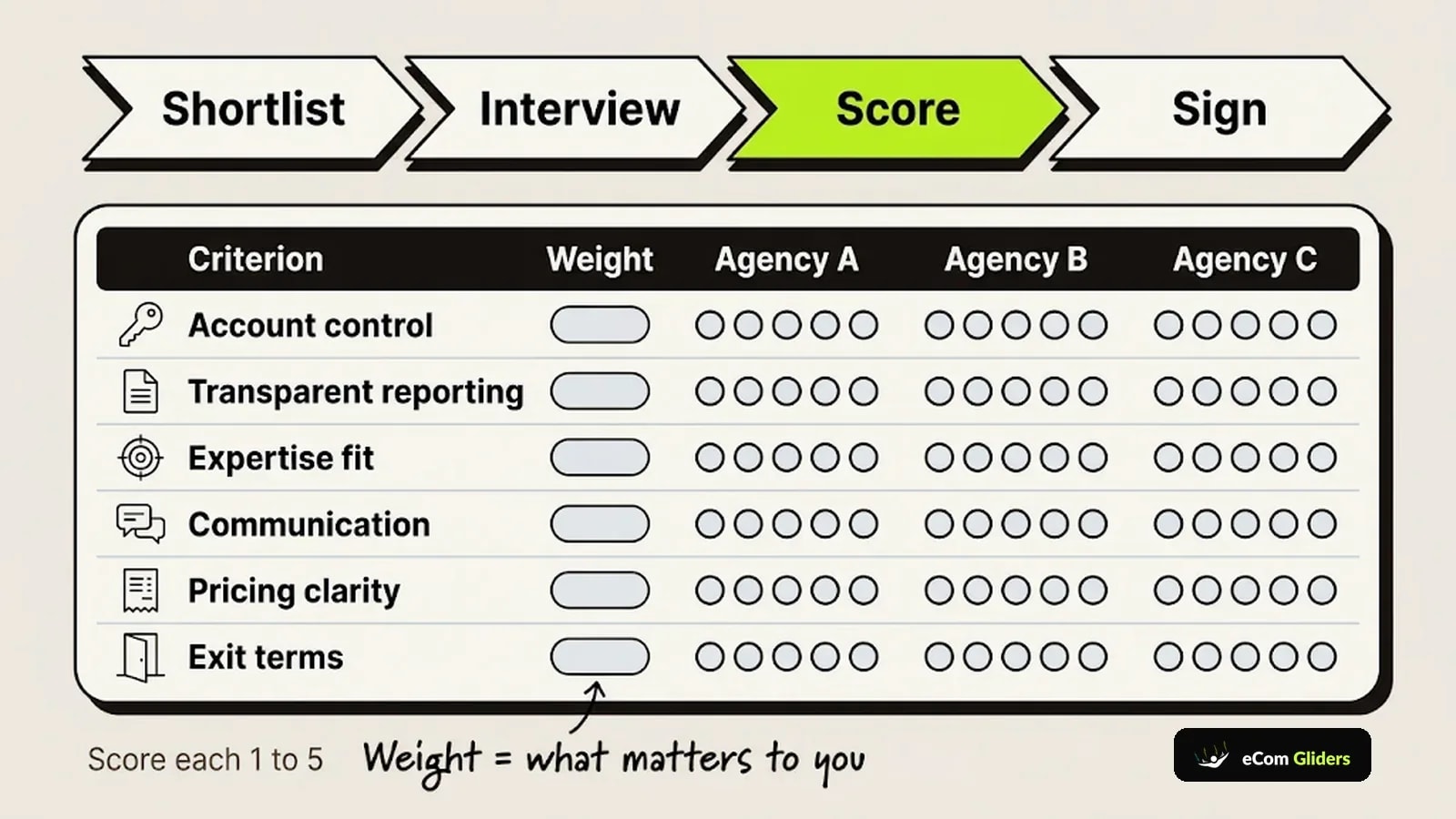
A high score on fit cannot make up for a failing score on access or ownership. If an agency fails either of those, remove it from the list regardless of the total.
Want a second opinion before you sign? You can request a free account audit and we will review your current setup against this checklist. Apply the same scorecard to us.
Choosing in 2027: what is and isn't changing
As of November 2026, we are not aware of any announced Amazon rule change specific to hiring agencies or service providers for 2027. The fundamentals here do not depend on any single policy. Badge programs and directory features do change, so check an agency's status on Amazon's own pages at the time you hire, not from an old pitch deck.
Bringing it together
Choosing an Amazon agency is less about finding the biggest name and more about finding a partner you can verify, measure and leave if needed. Shortlist from Amazon's own directories, ask every finalist the same 12 questions, and score them on fit, control and alignment before you sign a short first agreement.
If you would like an outside view of your account before you decide, request a free account audit. And if you are looking for ongoing day-to-day help, you can see how our Amazon account management works and judge it by the same standards.
About the author
Mary
Content Specialist
Mary writes practical Amazon seller guides covering PPC, SEO, listing optimization, and account management.
Keep reading