Full Account Management Services
Amazon "Frequently Returned Item" Badge After the Holidays: Why It Appears and How to Get It Removed
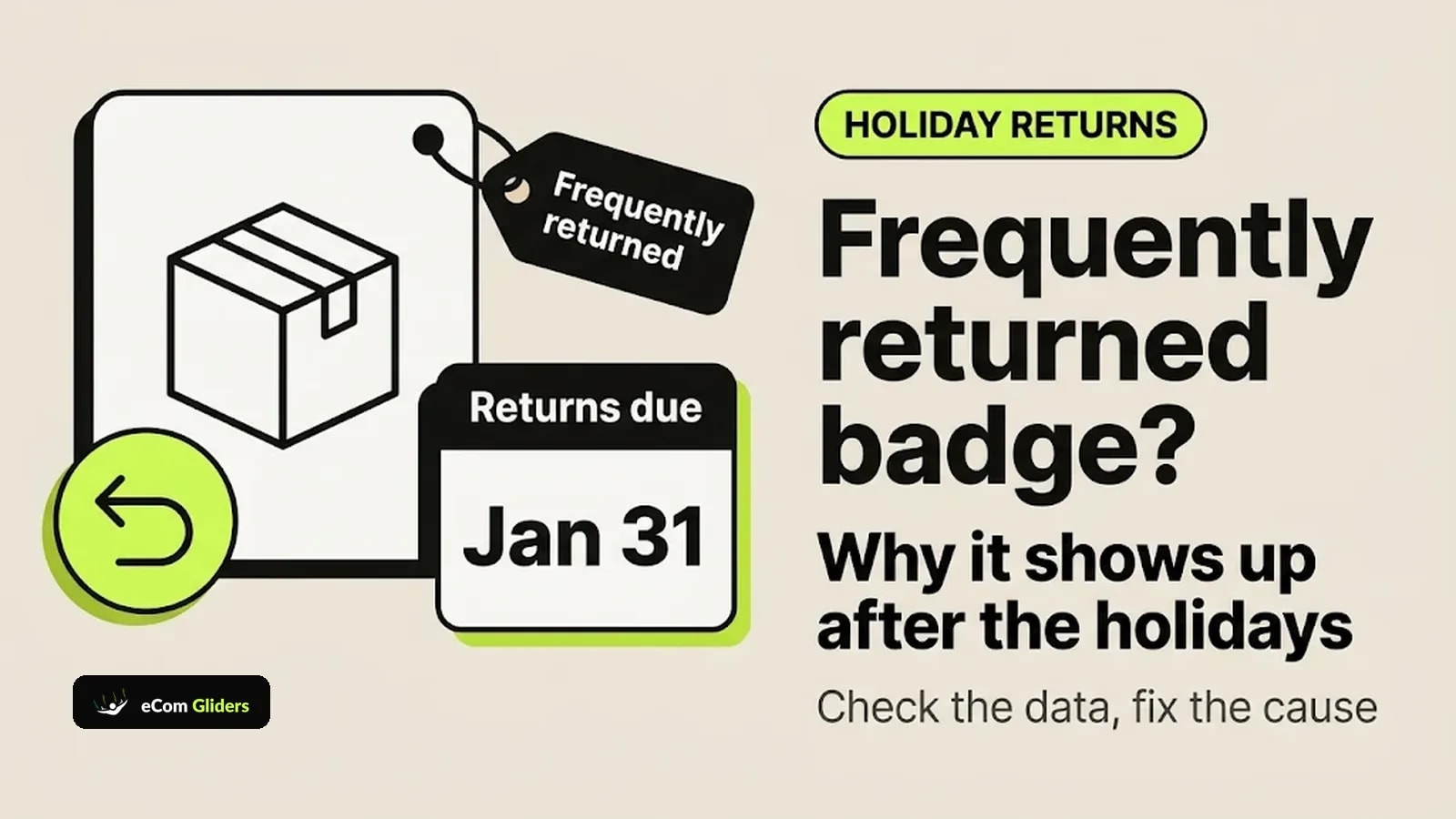
Holiday purchases stay returnable until January 31, and Amazon judges return rates against similar products. Here is why the Frequently Returned badge tends to appear after the holidays, how to check...
- November 24, 2026
- 11 min read
- Mary
Key takeaways
- What is the Frequently Returned badge, and how does Amazon decide who gets it?
- Why does the badge often appear in January and February?
- Is your return rate real? A five-check data diagnostic
Table of contents
Last checked: November 24, 2026. Updated for the 2026 holiday return season.
Amazon shows the Frequently Returned Item badge when an ASIN's return rate is high compared with similar products in its category. Amazon has not published a threshold, and there is no appeal or removal request. Amazon staff say the badge comes off automatically once the return rate falls back toward the suggested rate shown in Voice of the Customer. The badge often shows up in January and February because holiday purchases stay returnable until January 31, and those returns land in the recent period Amazon measures. To get it removed, confirm your return data is accurate, fix the listing and product causes behind your top return reasons, and track the rate in Voice of the Customer until it drops.
This guide is for US brand owners and FBA or FBM sellers with a badged ASIN, an at-risk warning, or a gift-heavy catalog heading into January.
What is the Frequently Returned badge, and how does Amazon decide who gets it?
The Frequently Returned Item badge is a shopper-facing label on an individual ASIN. Amazon assesses it by comparing that ASIN's return rate with similar ASINs in the same category, so the same rate can be normal in one category and high in another. Amazon has not published a percentage that triggers the badge, so be wary of any article that quotes one. See the Amazon moderator's explanation of how the badge is assigned, posted on the Seller Forums about two years ago. The official help page sits behind the Seller Central sign-in, so recheck it in your account.
In the same reply, the moderator said the return rate is based on the number of shipped units for which customers started a return, so it counts units, not orders. Check those counts in your own Voice of the Customer data.
Where do I see the badge and my return rate?
Go to Performance > Voice of the Customer in Seller Central. In a Seller Forums post, Amazon described these badge tools:
- A Return badge displayed column showing which ASINs carry the badge
- At-risk warnings for ASINs heading toward it
- 3-month and 12-month return rates
- Suggested return rates, meaning the rate Amazon suggests you reach to prevent or remove the badge
According to the moderator reply linked above, there is no master list of badged ASINs, so large catalogs need checking ASIN by ASIN.
Is the badge the same as the returns processing fee?
No. The returns processing fee is an FBA charge that Amazon introduced on June 1, 2024 for products with high return rates. In its announcement on the Seller Forums, Amazon said the fee:
- is measured over three months, starting with the month units shipped
- applies only to units above the category's return rate threshold
- does not apply in months with fewer than 25 shipped units
- is billed after the measurement period closes
- excludes returns caused by Amazon error, per a staff reply in the same thread
A high return rate can trigger both, but the badge is a shopper-facing label and the fee is a cost. We do not quote current fee rates because we could not verify them at an Amazon source.
What Amazon has said and has not said
| Amazon has said | Amazon has not said |
|---|---|
| The badge compares an ASIN's return rate with similar ASINs in its category | Any numeric return rate that triggers the badge |
| Removal is automatic once the rate aligns with peers or nears the suggested rate | How long removal takes |
| The suggested rate refreshes periodically | Whether seasonal or gift returns are adjusted for |
| There is no master list of badged ASINs | How much the badge affects sales or ranking |
| Voice of the Customer shows badge status, at-risk warnings and suggested rates | Why Voice of the Customer and FBA returns numbers can differ |
Why does the badge often appear in January and February?
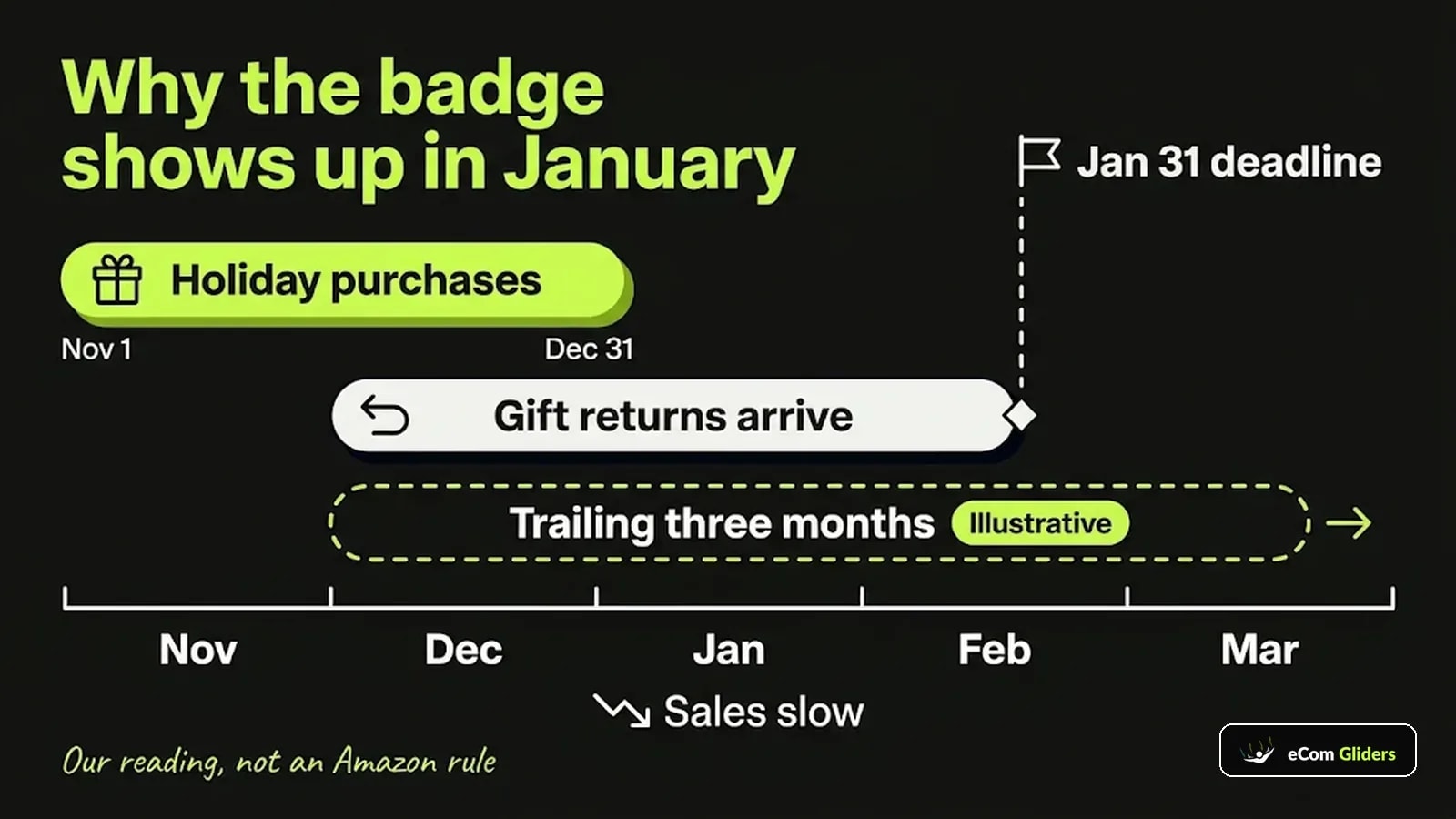
The short answer is timing: holiday purchases get a longer return window, and those returns arrive as sales slow down. For the 2026 season, most items bought from November 1 to December 31, 2026 can be returned through January 31, 2027 (Apple-branded products through January 15, 2027), according to Amazon's return policy page for customers. In an October 2026 Seller Forums announcement, Amazon told sellers the extended window applies automatically to FBA and FBM orders and will apply every year. The 2025 season worked the same way, with returns open until January 31, 2026. Outside the holidays, Amazon's standard policy lets customers return most items within 30 days of estimated delivery.
Our reading, not an Amazon statement: gift returns tend to cluster in late December and January. Voice of the Customer shows rates over recent months, including a 3-month view. January sales usually drop after peak. Fewer shipped units plus a wave of late gift returns can push the short-term rate up, even if nothing about your product changed. Seasonal and gift-driven ASINs feel this most.
A hypothetical example with made-up numbers: an ASIN ships 400 units from October to December and 20 come back, a 5% rate. In January, sales fall to 120 units and 15 gift returns arrive. On January alone, that is 12.5%. A trailing window that picks up late returns while volume is low will show a higher rate than your fourth quarter did. Amazon has not said whether it matches returns to the ship month or the return month, so read this as direction only.
Does Amazon adjust for seasonal or gift returns?
Not that Amazon has said. On the Seller Forums, a seller with a 4.8-star listing reported getting the badge after holiday returns and asked for seasonal adjustment. Amazon staff replied that the badge stays until the return rate improves. Plan as if holiday returns count.
Is your return rate real? A five-check data diagnostic
Before you rewrite a listing, make sure the number is accurate and you know where it comes from. Each check ends in fix, monitor, or open a case about the data. None ends in "appeal the badge," because no badge appeal exists.
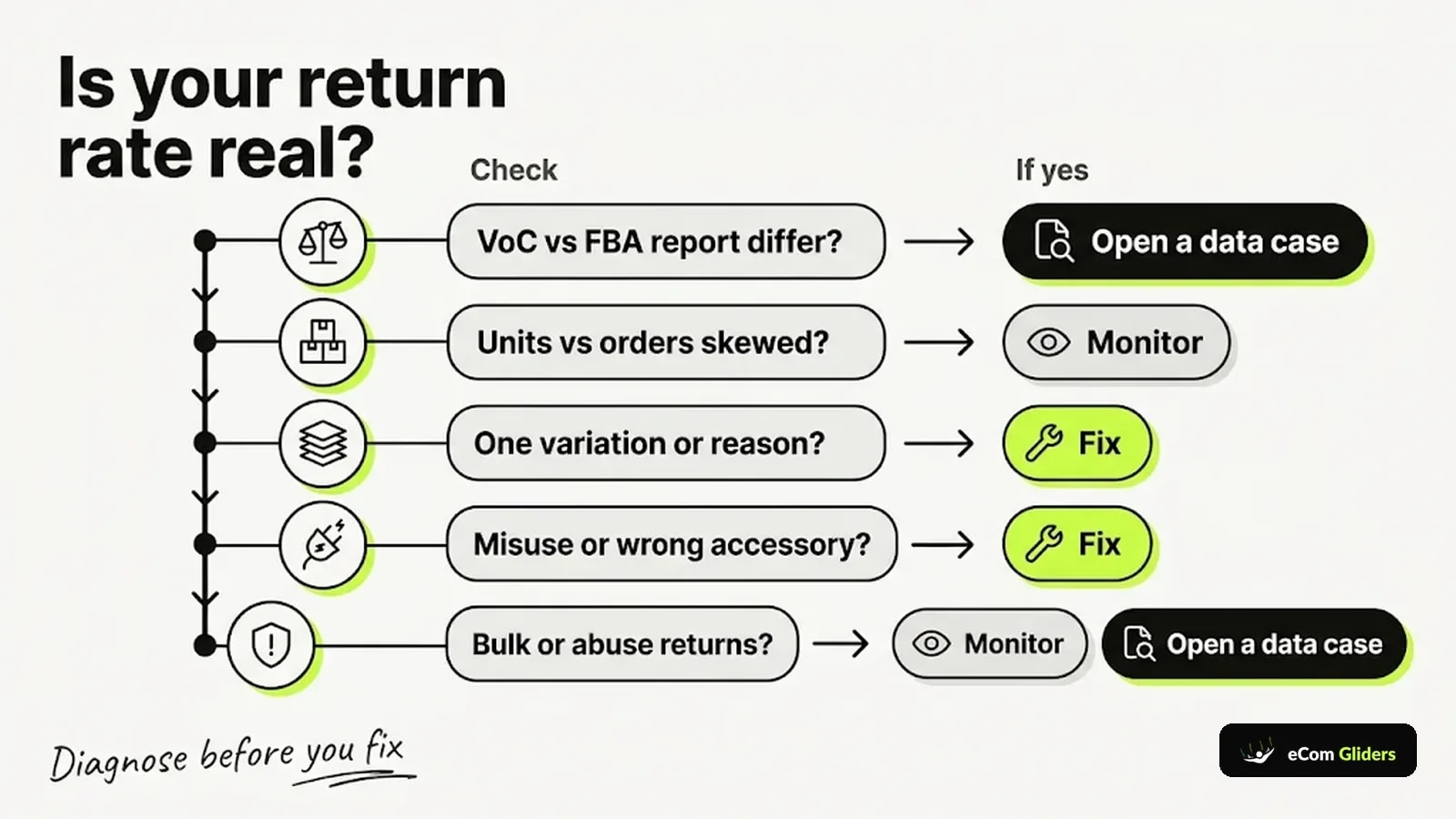
Check 1: Do Voice of the Customer and the FBA customer returns report agree?
Pull the FBA customer returns report in Seller Central for the period your Voice of the Customer rate covers. Sellers on Amazon's forums have reported gaps. One seller saw a 3.17% 90-day rate in the FBA returns report against an 8.52% short-term rate in Voice of the Customer. Another saw 13.64% in Amazon's three-month view while counting about 7.2% from their own records. Amazon has not explained why these numbers can differ.
Line up the windows, then compare units. FBM returns will not appear in an FBA report. If counts still differ, open a Seller Support case with the order IDs and ask for a review of the return data, a route Amazon staff suggested in one thread. Frame it as a data question, not a badge removal request. In another case, staff said an open fulfillment center inspection could not be expedited, so expect it to take time.
Check 2: Are you counting units or orders?
Because the rate counts units, one multi-unit order sent back in full can move it a lot. One seller described 9 units returned across two "bought by mistake" orders, out of 190 units sold in 30 days. Look for a few large returns before you assume a product problem.
Check 3: Is it one variation or one reason?
Sort returns by child ASIN and by return reason. A single size, color or bundle often drives most of the rate. If one variation is the problem, fix that variation's information and images first instead of reworking the whole listing.
Check 4: Is the product being misused or paired with the wrong accessory?
In one forum thread, a single-product brand selling a tire inflator said about 90% of its returns came from customers using the wrong charger. That is not a defect, but it still counts. The fix is clearer compatibility copy, a labeled image of the correct accessory, and an insert or quick-start card in the box.
Check 5: Are bulk, "bought by mistake" or suspected abuse returns involved?
Some returns are outside your control. Sellers interviewed by CNBC in June 2025 described being unable to block repeat returners, and forum sellers have blamed fake returns for their badge. Document patterns with order IDs and dates. Open a case for clear fulfillment or Amazon-side errors, but do not expect it to remove the badge.
| Signal you see | Likely explanation | What to do |
|---|---|---|
| Voice of the Customer and FBA returns report disagree | Different windows, units vs orders, FBM returns, or an unexplained data gap | Align windows; if still off, open a data review case with order IDs |
| A few large returns dominate | Multi-unit orders returned in full | Monitor; review bundle and quantity offers |
| One child ASIN or one reason dominates | Size, color or contents mismatch | Fix that variation's copy and images |
| Returns cite "doesn't work" but units test fine | Misuse or wrong accessory | Fix compatibility copy, images and inserts |
| Repeated returns with odd patterns | Possible abuse or Amazon-side error | Document; open a case for clear errors |
How do you fix the causes you control?
Start with the three areas Amazon itself points to. In a Seller Forums post on the badge from around December 2025, Amazon staff said most return problems trace back to product information accuracy, visual representation, and quality or packaging.
Fix the listing: titles, bullets, size and compatibility details
Ask what the customer expected and did not get, then put the answer in the listing:
- Size and fit: state measurements, not just labels like "medium," and add how to choose.
- Color: describe the color accurately and note any lighting differences.
- Compatibility: name what the product works with and what it does not.
- Contents: list exactly what is in the box.
Once the expectation mismatch is clear, work through the rest of the copy with our full listing optimization checklist.
Fix the images: show scale, contents and real color
Customer photos in reviews often show the gap between what you show and what shoppers receive, so start with what customer photos reveal about your listing.
Show the product in a hand or next to a familiar object for scale. Add a what's-in-the-box image. Check that the main and lifestyle images match the real color under normal light.
With Brand Registry, comparison charts, size guides and contents modules can help prevent wrong-variant purchases. These are the A+ Content modules built to set expectations that support your images.
Fix the product and packaging
Read inspection notes and "damaged" or "defective" return reasons. If units arrive damaged, packaging is the first place to look. If customers struggle with setup, a quick-start card or an insert with the compatible accessory can head off some of these returns.
Read reviews alongside return reasons
A review saying "smaller than expected" and a return reason saying "too small" are the same problem. Reading both helps you rank fixes.
How do you get the Frequently Returned badge removed?
You cannot request removal. According to Amazon staff on the Seller Forums, the badge is removed automatically once the ASIN's return rate aligns with similar products or nears the suggested rate, and the suggested rate refreshes periodically. There is no master list and no removal form.
Amazon has not published a threshold, a removal timeline, a seasonal adjustment or data on sales impact. Timelines quoted online, in weeks or months, do not come from Amazon. Amazon has not described any way to speed removal. Open a case only when the return data itself looks wrong.
What to track each week until it clears
This cadence is our recommendation, not Amazon guidance. Once a week, record for each affected ASIN:
- 3-month return rate and the suggested return rate
- at-risk or badge status
- top return reason
- which child ASIN the returns come from
What if sales have stopped and the rate cannot improve?
This is the hardest case. A single-SKU seller on Amazon's forums described sales stopping after the badge appeared, leaving no new units to lower the rate. Fix the root cause first, rebuild traffic carefully, and decide whether ad spend on the badged ASIN still makes sense for your margins.
Pre-holiday prevention checklist (do this before mid-December)
If you are reading this before Christmas, you can still change what holiday shoppers read before they buy. These are our recommendations and work year-round.
| Task | Why it matters | Where |
|---|---|---|
| Confirm size chart and compatibility details in bullets and images | Addresses common expectation mismatches | Listing, images |
| Add a what's-in-the-box image | Reduces "missing parts" and "not as described" returns | Images, A+ |
| Check color accuracy of main and lifestyle images | Reduces color-related returns | Images |
| Add a quick-start or compatibility insert | Reduces misuse returns | Packaging |
| Review the last 90 days of return reasons per child ASIN | Finds the variation driving returns | Voice of the Customer |
| Record your baseline 3-month rate and suggested rate per ASIN | Gives you a before-and-after comparison | Voice of the Customer |
| Set a weekly check through January and February | Catches a rising rate early | Voice of the Customer |
| Review multi-unit and bundle offers | Large returned orders can move a unit-based rate | Listing, pricing |
| Brief customer service on fit and compatibility questions | Answers questions before a wrong purchase | Buyer messages |
What's changing for returns in late 2026 and 2027?
As of November 24, 2026, here is where each change stands.
- Holiday window now annual (confirmed by Amazon). Amazon's October 2026 seller announcement says the November 1 to January 31 window will apply every year.
- Prepaid return labels for FBM from December 18, 2026 (reported by trade press). PPC Land, citing an Amazon email to sellers, reported that US seller-fulfilled returns, excluding heavy and bulky items, will require a prepaid return label. Sellers will reportedly have 7 calendar days to provide a label or refund, or Amazon may issue a returnless refund charged to the seller.
- Returns processing fee changes in 2027 (reported by trade press). PPC Land reported that the fee moves to size-tier rates for apparel and shoes on units shipped from January 15, 2027, and for other high-return categories from February 1, 2027. The report did not publish the rates, and Amazon's public 2027 fee letter does not mention the returns fee, so check the full fee summary in Seller Central. For the 2027 changes Amazon has confirmed, see our 2027 FBA fee changes action plan.
When to get a second pair of eyes
If several ASINs are at risk, or your Voice of the Customer numbers and returns report do not agree, a second look at listings and return reasons can show where to start. You can request a free listing and returns audit. We cannot remove the badge or promise a timeline, since only Amazon controls that, but we can help you find what is driving returns and what to fix first.
Frequently asked questions
No. Amazon describes removal as automatic once the return rate nears the suggested rate. You can open a case if the return data itself looks wrong, which is a different request.
Amazon gives no timeline. It depends on when your return rate nears the suggested rate, which Amazon says refreshes periodically.
Amazon has not said they are excluded. Under the extended window, most items bought from November 1 to December 31 can be returned through January 31, so plan as if those returns count.
Sellers report sales drops after the badge appears, but Amazon has not published data on its impact. Treat it as a conversion risk without assuming a specific number.
About the author
Mary
Content Specialist
Mary writes practical Amazon seller guides covering PPC, SEO, listing optimization, and account management.
Keep reading
Related articles
- Full Account Management ServicesAmazon FBM Offers Deactivated? How to Find the Cause, Reactivate, and Prevent It Before Peak Shipping9 min read
- Full Account Management ServicesHow to Choose the Best Amazon Agency in the USA (2027)10 min read
- Full Account Management ServicesMastering Amazon Account Management7 min read