Key takeaways
- Why did my Amazon organic rank drop suddenly?
- Common causes of a sudden ranking loss
- Diagnose before you spend more on ads
Table of contents
Why did my Amazon organic rank drop suddenly?
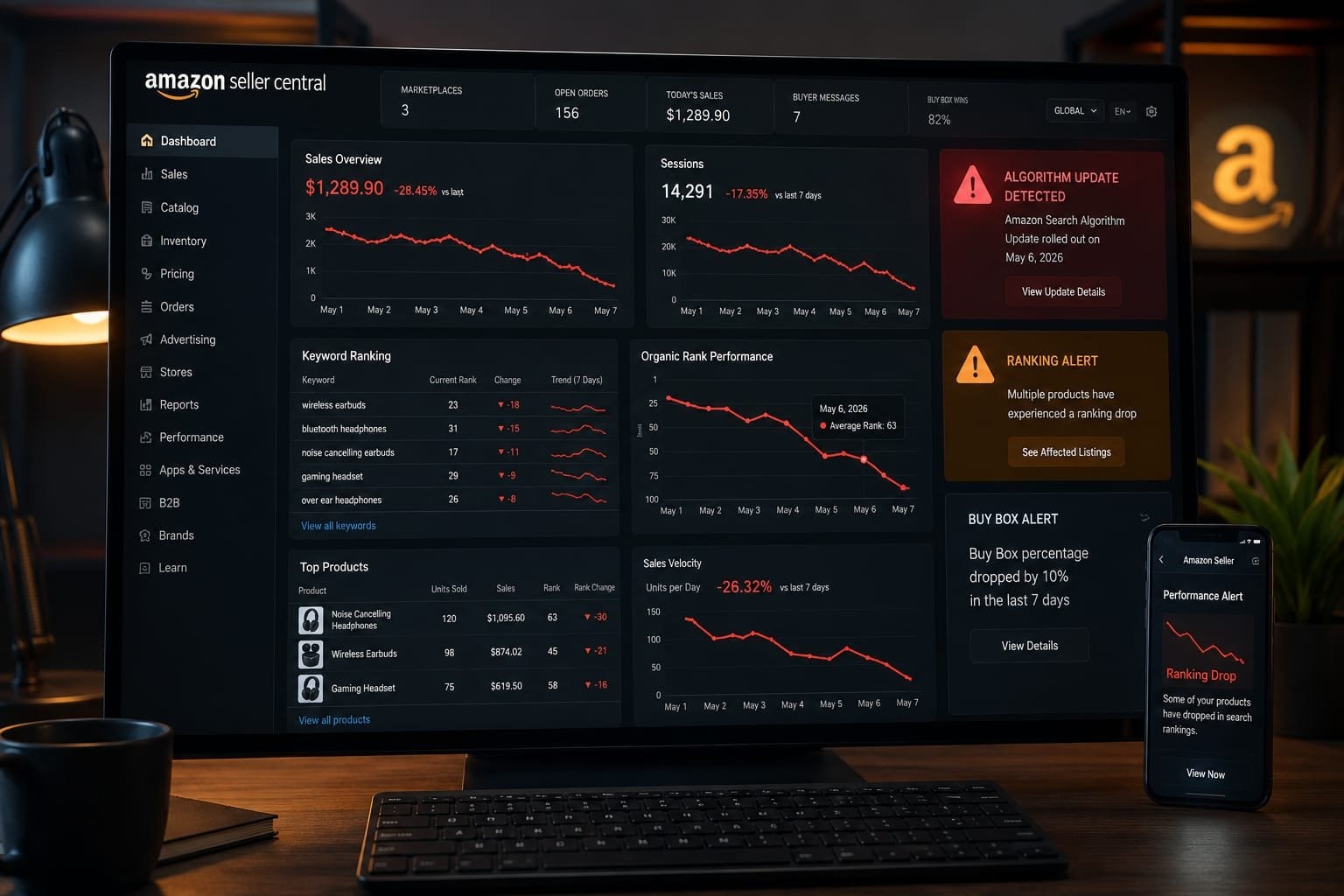
Amazon organic rank usually drops suddenly because of a change in sales velocity, listing health, inventory, reviews, competition, or search relevance - not because ads alone failed. In 2026, many sellers see abrupt visibility loss when conversion or buyability signals weaken, when a competitor improves the same keywords, or when Amazon search weighting shifts. Diagnose listing and inventory first; scale PPC only after the ASIN can convert again.
If the page still looks complete on paper but rank fell, treat it as a performance or operations problem until proven otherwise. Related: why your Amazon listing looks perfect but still does not rank, Amazon SEO ranking factors 2026, and Amazon A10 algorithm 2026.
Common causes of a sudden ranking loss
Sales velocity drop
Fewer daily orders often reduce organic visibility quickly. Velocity can fall after a stock gap, a price increase, weaker conversion, or a competitor launch that takes share on the same terms.
Listing suppression or buyability issues
Missing required images, policy problems, catalog errors, or other suppressions can hide or weaken the ASIN in search. Confirm the listing is still buyable, images load, and no search suppressions appear in Seller Central before changing bids.
Keyword demotion and competition
Main keywords can lose ground when competitors improve titles, creative, reviews, or PPC on the same queries. Your listing may not have "broken"; the relative competitive set may have improved.
Negative reviews and satisfaction signals
Poor ratings, repeated complaints, and higher return rates reduce trust and conversion. Because conversion supports rank, review quality can move organic positions even when keyword coverage looks unchanged.
Inventory and fulfillment gaps
Stockouts interrupt sales velocity and can damage keyword rankings and momentum. Restock planning is part of SEO recovery, not only operations.
Algorithm and relevance shifts
Search systems periodically reweight relevance and performance signals. When that happens, listings with weak conversion or inconsistent sales often lose more visibility than listings with stronger shopper outcomes. See Amazon silent ranking factors.
Diagnose before you spend more on ads
A sudden rank drop is often a listing or inventory problem first, not an advertising problem. Confirm:
- The ASIN is buyable and not suppressed
- Main image and gallery load correctly
- Price and offer remain competitive for the category
- Inventory covers near-term demand
- Recent reviews or returns did not spike
- Sales velocity fell for a clear reason (stock, price, competitor, conversion)
Only after those basics are stable should you scale PPC to rebuild keyword ranks. Otherwise ad spend buys clicks into a weak conversion path. For campaign support after the listing is healthy, see Amazon PPC management.
How to recover organic rankings
Practical recovery sequence:
- Fix buyability, images, and any Seller Central suppressions.
- Restore inventory and competitive offer presentation.
- Re-optimize title, bullets, and backend search terms for priority keywords without stuffing.
- Improve conversion with images, A+ content, and clearer benefit copy via Amazon listing optimization.
- Support priority keywords with profitable PPC once conversion is stable.
- Rebuild review quality only through compliant request methods and accurate listing expectations.
Recovery is usually gradual. Expect velocity and conversion work to lead rank movement, not a single backend keyword edit.
What matters most after a rank drop
In 2026, durable Amazon SEO still depends on relevance, sales consistency, and customer satisfaction. Sellers who diagnose the cause, stabilize the listing, and then support keywords with disciplined ads usually recover faster than sellers who only raise bids.
Request a free Amazon audit from eCom Gliders to review ranking loss causes across listing conversion, inventory, and PPC, or browse case studies for audit-led examples.
About the author
Mary
Content Specialist
Mary writes practical Amazon seller guides covering PPC, SEO, listing optimization, and account management.
Keep reading